The Income Tax Appellate Tribunal, Ahmedabad, has delivered a significant ruling clarifying the limits of revisionary powers under Section 263 of the Income Tax Act, particularly in relation to Minimum Alternate Tax (MAT) computations. The Tribunal held that neither CSR expenses nor disallowances under Section 14A can be added back to book profit when the assessee is liable to pay tax under Section 115JB, and that the Assessing Officer’s failure to examine these issues does not render the assessment order erroneous or prejudicial to revenue interests.
Background & Facts
The Dispute
The appellant, Shalby Ltd., a healthcare provider based in Ahmedabad, filed its return of income for Assessment Year 2020-21 on 28.05.2021, declaring a total income of Rs. 6,83,24,890. The case was selected for complete scrutiny under the Computer Assisted Selection System (CASS). During assessment, the Assessing Officer (AO) disallowed Rs. 35,96,047 under Section 80G for donations claimed to the All India Social Education and Charitable Trust (AISECT). However, the AO did not examine whether the Rs. 3 crore CSR expense paid to AISECT should be adjusted in the computation of book profit under Section 115JB for MAT purposes, nor did the AO consider disallowance under Section 14A read with Rule 8D for exempt income earned from investments in firms and LLPs.
Key Facts
- The assessee debited Rs. 3,00,00,000 as CSR expenditure to its Profit & Loss account in respect of donations to AISECT
- The assessee claimed deduction under Section 80G for Rs. 62,04,674 (50% of Rs. 1,24,09,348), of which Rs. 31,02,337 was allowed and Rs. 35,96,047 was disallowed by the AO
- The book profit for MAT computation was calculated without any adjustment for the Rs. 3 crore CSR expense
- The assessee earned exempt income of Rs. 25,28,041 from investments in firms and LLPs
- The assessee paid tax under Section 115JB (MAT) for A.Y. 2020-21
- A search operation under Section 132 was conducted on AISECT in March 2021, revealing it was part of a bogus donation scheme
- The Principal Commissioner of Income Tax (PCIT) invoked Section 263 on 30.03.2025 to set aside the AO’s order dated 27.09.2022
Procedural History
- 28.05.2021: Return of income filed for A.Y. 2020-21
- 27.09.2022: AO completed assessment under Section 143(3), disallowing Rs. 35,96,047 under Section 80G but not adjusting CSR expense for MAT
- March 2021: Search action conducted on AISECT by Income Tax Department
- 30.03.2025: PCIT passed order under Section 263, setting aside AO’s order on two grounds:
- Failure to disallow Rs. 3 crore CSR expense from book profit for MAT computation
- Failure to apply Rule 8D for disallowance of Rs. 33,83,655 relating to exempt income of Rs. 25,28,041
- 23.02.2026: Hearing before ITAT Ahmedabad
- 26.03.2026: Judgment pronounced
The Parties' Positions
For the Appellant (Shalby Ltd.)
- CSR expenses are not required to be added back to book profit under Section 115JB as they are not listed in the Explanation to Section 115JB
- The AO had already examined the donation issue and disallowed part of it under Section 80G
- The PCIT’s reliance on search findings to revisit the issue was impermissible as the AO had already applied his mind
- The Gujarat High Court in PCIT v. Gujarat Fluorochemicals Limited held that Section 14A disallowances cannot be imported into book profit under Section 115JB
- The Delhi High Court in PCIT v. Sony India Pvt. Ltd. held that CSR expenses cannot be excluded from final accounts for MAT computation
For the Respondent (PCIT)
- The Rs. 3 crore donation to AISECT was bogus, as revealed by search proceedings, and should have been disallowed from book profit
- The AO failed to apply Rule 8D for disallowance of expenses attributable to exempt income
- The omission rendered the assessment order erroneous and prejudicial to revenue interests
- The PCIT was duty-bound to correct such errors under Section 263
Relief Sought
The appellant sought quashing of the PCIT’s order dated 30.03.2025, restoration of the AO’s order dated 27.09.2022, and confirmation that no adjustment to book profit was required for CSR expenses or Section 14A disallowances.
The Legal Issue
The central question was whether the Assessing Officer’s failure to disallow CSR expenses from book profit under Section 115JB or to apply Rule 8D for exempt income rendered the assessment order erroneous and prejudicial to the interest of revenue, thereby justifying revision under Section 263.
Arguments Presented
For the Appellant
The appellant relied on PCIT v. Sony India Pvt. Ltd. (167 taxmann.com 549) and Apollo Tyres Limited v. CIT (122 Taxman 562) to argue that the AO has no power to go behind the audited financial statements unless specifically permitted under the Explanation to Section 115JB. CSR expenses, being a legitimate accounting entry under the Companies Act, cannot be added back to book profit. Further, the Gujarat High Court in PCIT v. Gujarat Fluorochemicals Limited (155 taxmann.com 549) held that disallowances under Section 14A cannot be imported into book profit when tax is computed under Section 115JB. The appellant emphasized that the AO had already examined the donation issue and made a disallowance under Section 80G, and the PCIT could not reopen the matter on the basis of post-assessment search findings.
For the Respondent
The PCIT contended that the Rs. 3 crore payment to AISECT was a sham transaction, as confirmed by search proceedings, and therefore should have been disallowed from book profit to prevent tax avoidance. The omission to apply Rule 8D for exempt income, he argued, resulted in understatement of tax liability. The PCIT asserted that Section 263 empowers him to correct any error that is prejudicial to revenue, even if the AO had applied his mind, provided the error is apparent on record.
The Court's Analysis
The Tribunal examined the scope of revisionary powers under Section 263, which permits the Commissioner to set aside an assessment order only if it is both erroneous and prejudicial to the interest of revenue. The Tribunal held that the AO’s order was neither erroneous nor prejudicial on either ground.
"The AO could not have disturbed the book profit and the adjustment on account of CSR expenses could not have been made as per Explanation to section 115JB of the Act."
The Tribunal noted that the Explanation to Section 115JB explicitly lists the items that can be adjusted to arrive at book profit. CSR expenses are not among them. The Supreme Court in Apollo Tyres Limited had held that the AO cannot go behind the audited accounts unless the adjustment is specifically permitted under the statute. The Delhi High Court in Sony India had similarly held that CSR expenses, being a statutory obligation under the Companies Act, form part of the profit and loss account and cannot be excluded for MAT purposes.
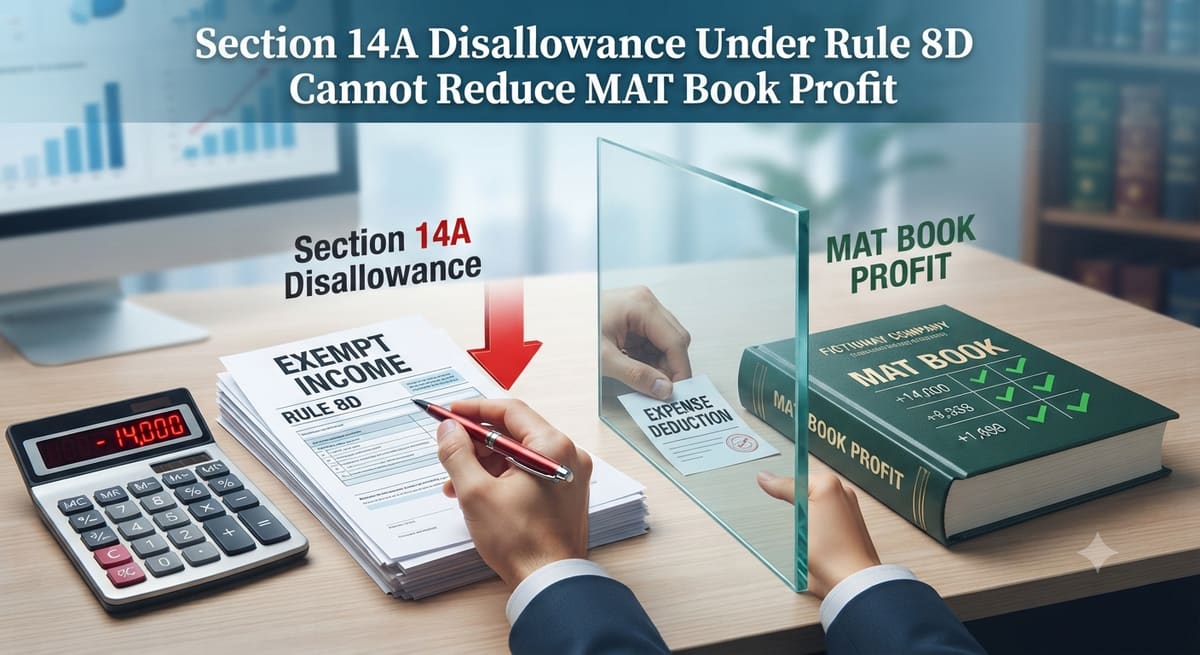
Regarding Section 14A and Rule 8D, the Tribunal observed that the assessee had paid tax under Section 115JB, not under normal provisions. The Gujarat High Court in Gujarat Fluorochemicals Limited had held that disallowances under Section 14A are irrelevant for book profit computation under Section 115JB. The Tribunal emphasized that the purpose of MAT is to tax book profit as per accounting standards, and Section 14A disallowances are meant for normal income computation.
The Tribunal further held that the PCIT’s reliance on search findings post-assessment could not be used to declare the AO’s order erroneous. The AO had already examined the donation claim and made a disallowance under Section 80G. The fact that the donation was later found to be part of a larger scam did not make the AO’s assessment erroneous at the time it was passed.
The Verdict
The appeal of the assessee is allowed. The order of the Principal Commissioner of Income Tax dated 30.03.2025 under Section 263 is quashed. The assessment order dated 27.09.2022 passed by the Assessing Officer is restored. No adjustment to book profit is required for CSR expenses of Rs. 3 crores or for disallowance under Section 14A read with Rule 8D. The tax liability stands computed as per the original assessment.
What This Means For Similar Cases
CSR Expenses Are Not Adjustments for MAT
- Practitioners must argue that CSR expenses, even if later found to be fraudulent, cannot be added back to book profit under Section 115JB unless specifically permitted by the Explanation
- The AO’s role is limited to verifying the accounting entries; he cannot recharacterize expenses as non-deductible for MAT purposes
- Any attempt to disallow CSR expenses under Section 263 on grounds of fraud must be rejected if the expense was properly recorded in the books
Section 14A Disallowances Are Irrelevant Under MAT
-
When an assessee is liable under Section 115JB, disallowances under Section 14A and Rule 8D cannot be imported into book profit
-
The Tribunal’s reliance on Gujarat Fluorochemicals Limited establishes a binding precedent for all jurisdictions
-
Tax officers must not invoke Section 263 to correct omissions in Section 14A computation when MAT applies
-
Practitioners should raise this as a jurisdictional bar in any revision or appeal involving MAT and exempt income
-
Always verify whether the assessee is liable under normal provisions or MAT before raising Section 14A issues
-
Do not rely on post-assessment search findings to challenge an AO’s order under Section 263 unless the error was apparent on the record at the time of assessment
-
Maintain clear documentation of CSR expenses as statutory obligations under the Companies Act to strengthen defense against arbitrary adjustments