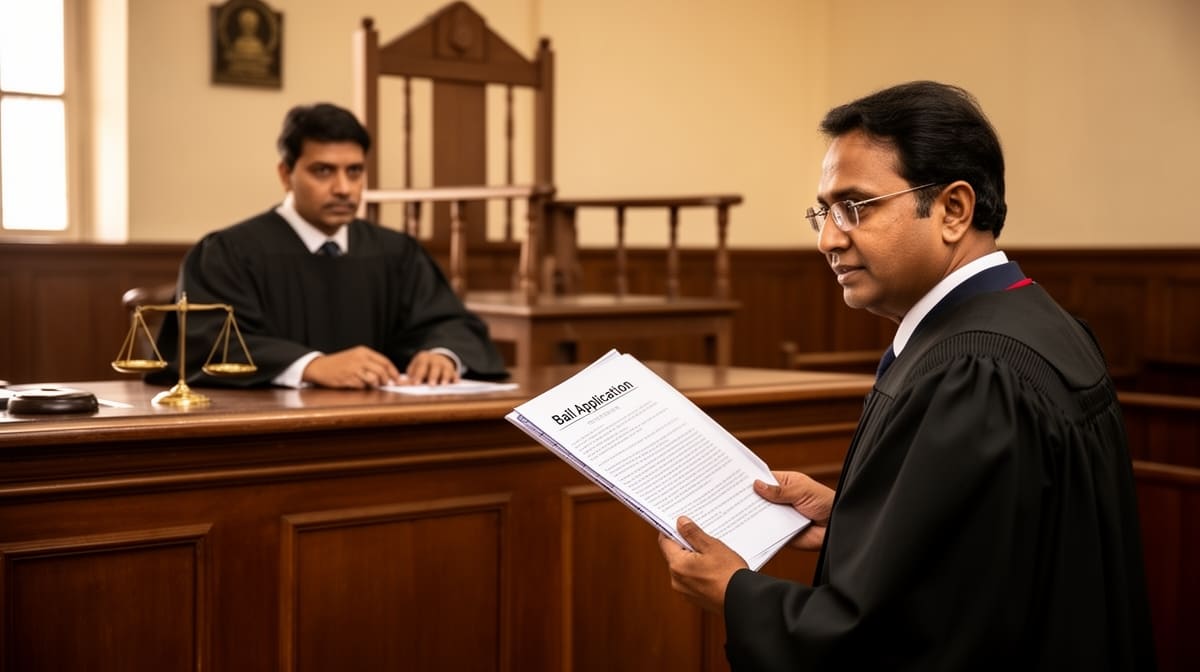
The Punjab and Haryana High Court has reaffirmed that prolonged pre-trial incarceration, even in grave criminal cases, cannot justify continued detention when trial progress is unduly delayed. In a significant clarification of bail jurisprudence, the Court granted regular bail to a petitioner who had spent over five years in custody, emphasizing that the right to liberty under Article 21 cannot be indefinitely suspended due to procedural stagnation.
Background & Facts
The Dispute
The petitioner, Ravinder Kali @ Rajput, was named in FIR No. 257/2014 registered at Police Station Chandimandir for offences under Sections 148, 149, 307, 452 IPC and Sections 25, 54, 59 of the Arms Act, relating to a violent attack on the owners of Dark Knight Café. The incident involved armed assailants firing guns and wielding swords, resulting in grievous injuries to the complainant, including a gunshot wound and multiple fractures. The prosecution alleged a conspiracy rooted in a prior dispute involving Lawrence Bishnoi and his associates.
Procedural History
The case has progressed through multiple stages over more than a decade:
- 28.04.2015: Petitioner arrested and later granted regular bail by this Court on 02.12.2016
- May 2017: Petitioner failed to appear before trial court due to miscommunication with counsel
- 06.10.2017: Petitioner declared a proclaimed offender
- 31.08.2020: Petitioner re-arrested and has remained in custody since
- 26.11.2025: Previous bail petition (CRM-M-29395-2025) withdrawn
- 15.02.2026: Custody certificate filed showing total incarceration of 5 years, 5 months and 16 days
Relief Sought
The petitioner seeks regular bail, arguing that his prolonged detention without trial conclusion violates his fundamental rights and that no risk of flight or evidence tampering has been demonstrated.
The Legal Issue
The central question was whether a second or successive bail petition can be entertained after a prior petition was withdrawn or dismissed, and whether extended pre-trial incarceration alone can justify the grant of bail in a case involving serious non-bailable offences.
Arguments Presented
For the Petitioner
Counsel relied on Rafiq Khan v. State of Haryana (CRA-S-2332-2023) to argue that successive bail petitions are legally maintainable regardless of the nature of prior dismissal. He emphasized that the petitioner had suffered over five years in custody without trial conclusion, and that no concrete evidence suggested risk of absconding or tampering. He further cited Maulana Mohd. Amir Rashadi v. State of U.P. and Sridhar Das v. State to underscore that delay in trial weighs heavily in bail considerations.
For the Respondent
The State contended that the gravity of offences - particularly Section 307 IPC and Arms Act violations - rendered the petitioner a flight risk and a threat to public order. It argued that the petitioner’s prior declaration as a proclaimed offender and involvement in multiple FIRs disqualified him from bail. The State relied on the custody certificate to assert that the petitioner’s incarceration was justified given the seriousness of the allegations.
The Court's Analysis
The Court rejected the notion that successive bail petitions are per se non-maintainable. It adopted the principles laid down in Rafiq Khan v. State of Haryana, holding that a second bail petition is maintainable even if the earlier one was withdrawn or dismissed on merits. The Court emphasized that the key criterion is not the number of petitions, but whether there has been a substantial change in circumstances.
"The metaphoric expression of seeking second/successive bail plea(s) ought not be abstracted into literal iterations of petition(s) without substantial, effective and consequential change in circumstances."
The Court found that the passage of over five years in custody, coupled with the absence of any meaningful trial progress, constituted such a substantial change. It noted that the trial had not advanced to the stage of evidence recording despite the case being pending for more than a decade. The Court further held that the mere fact of multiple FIRs or prior absconding does not automatically negate bail eligibility if the current case does not demonstrate a real risk of interference with justice.
The Court distinguished between the gravity of the offence and the necessity of detention, affirming that prolonged incarceration without trial cannot be sustained merely on the basis of the nature of allegations. It cited Maulana Mohd. Amir Rashadi to reinforce that the right to liberty under Article 21 must prevail unless the State demonstrates a compelling reason for continued custody.
The Verdict
The petitioner won. The Court held that successive bail petitions are maintainable and that extended pre-trial incarceration without trial progress justifies release, even in serious cases. The petitioner was granted regular bail subject to strict conditions.
What This Means For Similar Cases
Successive Bail Petitions Are Not Barred
- Practitioners may file successive bail petitions even after prior withdrawal or dismissal
- Courts must examine substantive changes in circumstances, not procedural history alone
- A mere repetition of earlier arguments without new facts will not suffice
Delay in Trial Overrides Gravity of Offence
- In cases where trial has stalled for years, courts must prioritize the accused’s right to liberty
- The burden shifts to the State to justify continued detention beyond a reasonable timeframe
- Courts should not defer bail decisions indefinitely on the basis of alleged seriousness alone
Conditions Must Be Specific and Enforceable
- Bail conditions must be clear, measurable, and tailored to prevent abuse
- Mandatory conditions like passport deposit, phone number disclosure, and no-contact orders are now standard in such grants
- Breach of conditions must be actionable without requiring fresh arrest