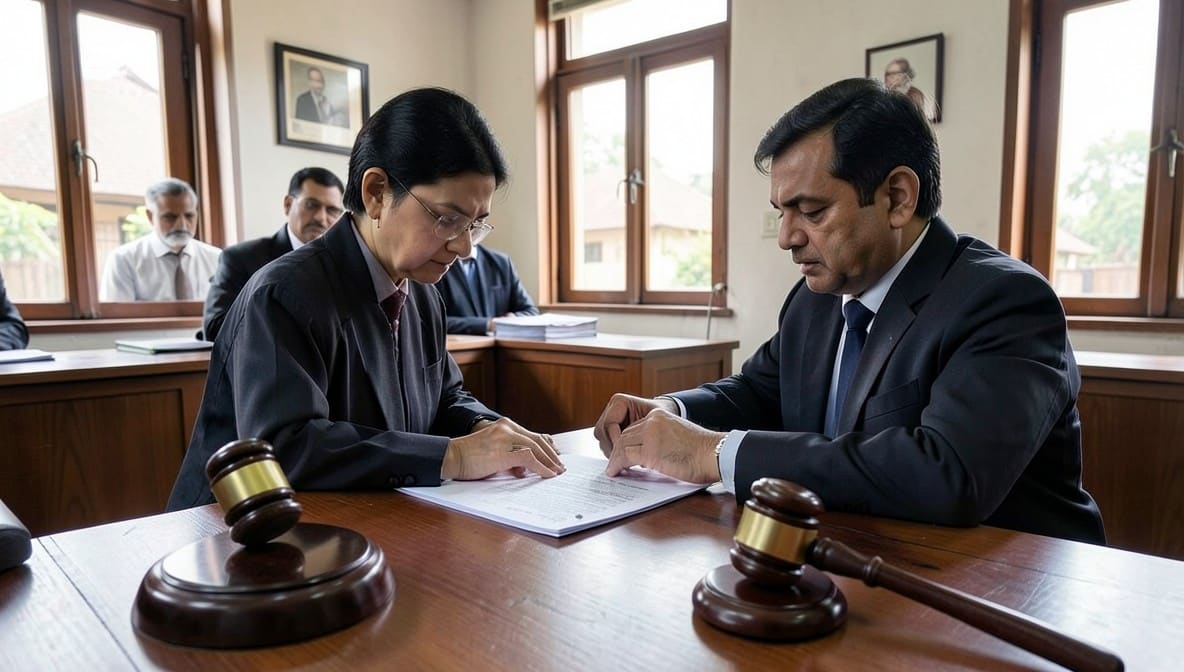
The Madhya Pradesh High Court has granted bail to a convicted appellant under the Scheduled Castes and Scheduled Tribes (Prevention of Atrocities) Act despite a life sentence, holding that the absence of gunshot injuries and over-implication render the case fit for suspension of sentence. This decision underscores the court’s discretion to balance procedural fairness against the gravity of conviction when factual inconsistencies undermine the prosecution’s narrative.
Background & Facts
The Dispute
Appellant No. 10, Mahesh, was convicted and sentenced for offences under Section 148 of the Indian Penal Code (IPC) read with Section 3(2)(v) of the SC/ST Act, and Section 302/149 IPC read with Section 3(2)(v) of the SC/ST Act. The charges arose from an alleged mob attack resulting in the death of a member of a Scheduled Caste community. The prosecution alleged that Mahesh, along with other accused, was present at the scene armed with a country-made pistol, hard and blunt objects, and a rifle (referred to as "big bandook").
Key Facts
- The incident occurred on the date mentioned in the FIR, though the exact date is not specified in the judgment
- The deceased sustained lacerated wounds, as per the postmortem report
- No gunshot wounds were found on the deceased’s body
- The prosecution relied on the testimonies of Satendra Parihar (PW-1) and Dharamsingh Parihar (PW-2)
- The FIR alleged use of both firearms and blunt weapons, but the medical evidence contradicted the use of a firearm
- Appellant No. 10 claims he was over-implicated and had no direct role in causing fatal injuries
- The trial is ongoing and expected to take a prolonged period
Procedural History
- Date of conviction and sentencing: Not specified in judgment, but prior to 2024
- 10.05.2024: Criminal Revision No. 10592 of 2024 filed before the High Court at Gwalior
- 25.05.2025: I.A. No. 25590/2025 filed under Section 430 of the Bharatiya Nagarik Suraksha Sanhita (BNSS) seeking suspension of sentence and grant of bail
- 04.05.2026: Hearing concluded on the interim application
The Parties' Positions
For the Appellant
Counsel for Mahesh argued that:
- The postmortem report conclusively shows no gunshot injury, undermining the allegation that Mahesh fired a pistol
- The use of blunt objects by others suggests Mahesh’s involvement was peripheral
- He has no history of absconding or tampering with evidence
- The trial is likely to extend for years, warranting interim relief
- His continued incarceration is disproportionate given the evidentiary gap
For the Respondent/State
The Public Prosecutor opposed the application, contending that:
- The offences under Section 302/149 IPC and Section 3(2)(v) of the SC/ST Act are grave and attract mandatory minimum punishment
- The presence of the accused at the scene of a violent mob attack justifies continued custody
- Suspension of sentence in such cases sets a dangerous precedent
Relief Sought
Appellant No. 10 sought:
- Suspension of his sentence pending appeal
- Grant of bail on personal bond with surety
- Exemption from regular appearances before the High Court registry
The Legal Issue
Can a convicted accused under Section 302/149 IPC and Section 3(2)(v) of the SC/ST Act be granted bail and suspension of sentence when the prosecution’s key allegation (use of firearm) is contradicted by the postmortem report, and the trial is likely to be protracted?
Arguments Presented
For the Appellant
Counsel relied on the principle that bail is the rule and jail the exception, even post-conviction, where the conviction is questionable or the sentence disproportionate. He cited the absence of gunshot injuries as a material inconsistency that casts doubt on the appellant’s direct involvement in the fatal act. He emphasized that Section 430 BNSS permits suspension of sentence pending appeal if the court is satisfied that the appellant is not likely to abscond or tamper with evidence. The argument was that the factual contradiction between the FIR and postmortem report creates a reasonable ground for doubt, warranting interim liberty.
For the Respondent/State
The State contended that the nature of the offences - particularly under the SC/ST Act - demands strict adherence to custody, as such crimes are considered socially heinous. It argued that presence at the scene of a mob killing, even without firing a weapon, constitutes participation in a common object under Section 149 IPC. The State further asserted that suspension of sentence in such cases would undermine deterrence and public confidence in the justice system.
The Court's Analysis
The Court undertook a careful review of the evidentiary record, particularly the postmortem report and the FIR. It noted that while the FIR alleged the use of a country-made pistol and rifle, the postmortem report recorded only lacerated wounds consistent with blunt and hard objects. The absence of any gunshot wound was decisive.
"No gunshot injury was sustained by deceased which clearly indicates that no gunshot was fired for causing injury to deceased."
The Court held that this discrepancy significantly weakens the prosecution’s case against Mahesh, who was specifically alleged to have been in possession of a pistol. The Court observed that the appellant’s role, if any, appears limited to presence at the scene, without direct causation of the fatal injury. The Court further noted that the trial is likely to be prolonged, and there is no indication of risk of absconding or tampering with evidence.
The Court emphasized that Section 430 BNSS grants discretionary power to suspend sentence pending appeal, and this discretion must be exercised with a view to justice, not merely procedural rigidity. The Court distinguished this case from those involving direct, unchallenged acts of violence, noting that the evidentiary contradiction here justifies interim relief.
The Verdict
The appellant succeeded. The High Court allowed I.A. No. 25590/2025 and suspended the remaining jail sentence of Appellant No. 10, Mahesh. He was granted bail on furnishing a personal bond of Rs. 1,00,000 with one surety of like amount, to be approved by the Trial Court. He is permanently exempted from appearing before the Registry of the High Court and shall appear only when directed by the Trial Court.
What This Means For Similar Cases
Evidentiary Contradictions Can Justify Post-Conviction Bail
- Practitioners must highlight inconsistencies between FIR allegations and forensic evidence (e.g., postmortem, ballistic reports) when seeking bail under Section 430 BNSS
- Absence of physical corroboration for weapon allegations can undermine the prosecution’s narrative even in serious cases
- Courts are willing to grant interim relief where the conviction appears disproportionate to the proven conduct
SC/ST Act Convictions Are Not Automatically Barred from Bail
- Conviction under the SC/ST Act does not create an absolute bar to bail or suspension of sentence
- The court’s discretion under Section 430 BNSS remains intact, even in cases involving social atrocities
- The gravity of the offence must be weighed against the strength of the evidence and likelihood of prolonged trial
Procedural Fairness Trumps Presumption of Guilt in Interim Relief
- The presumption of innocence retains relevance in bail proceedings even after conviction
- Courts may consider the risk of undue incarceration pending appeal, especially where factual doubts persist
- Exemption from registry appearances is a practical tool to reduce procedural burden on acquitted or partially exonerated accused