The Patna High Court has granted anticipatory bail to four accused persons in a case registered under the Scheduled Castes and Scheduled Tribes (Prevention of Atrocities) Act, 1989, emphasizing that delayed reporting, private commercial disputes, and absence of public visibility undermine the prima facie case for denial of bail.
Background & Facts
The Dispute
The dispute originated from a commercial transaction involving the purchase of a Mahindra tractor. The informant, Sudesh Paswan, alleged that on 29.06.2022, he purchased the tractor from Santosh Sah (Appellant No.1) for Rs.3,76,000, paying Rs.2,16,000 as advance. He claimed the appellants assured him that repairs would cost between Rs.10,000 and Rs.12,000, but he ultimately incurred Rs.60,000 in repair expenses. The appellants allegedly promised to take back the tractor and refund the money, but instead forcibly seized it on 26.09.2024.
Key Facts
- The alleged incident of forcible seizure occurred on 26.09.2024
- A panchayati meeting was convened on 21.11.2024 at 7:00 PM to resolve the dispute, during which the appellants allegedly agreed to repay the amount
- On the same day (21.11.2024), the informant and his wife alleged they were abused using caste-based slurs and physically assaulted at the appellants’ residence
- The FIR was registered on 03.02.2025, over 78 days after the alleged incident
- The case was registered under Sections 126(2), 115(2), 316(2), 318(2), 352, 351(2), and 3(5) of the Bharatiya Nagarik Suraksha Sanhita, 2023, and Sections 3(i)(x) of the SC/ST Act
- The appellants are residents of Village Bara Shankar, Patahi, East Champaran, Bihar
- The informant is also a resident of the same village
Procedural History
- 21.11.2024: Alleged incident of abuse and assault
- 26.09.2024: Alleged forcible seizure of tractor
- 03.02.2025: FIR registered at Patahi Police Station as Case No.43/2025
- 01.05.2025: Application for anticipatory bail (A.B.P. No.1131/2025) rejected by the trial court
- 23.04.2026: Criminal Appeal (SJ) No.2369 of 2025 filed before the Patna High Court
- 30.04.2026: Oral order passed by the High Court
Relief Sought
The appellants sought anticipatory bail to prevent arrest in connection with the FIR, arguing that the case was fabricated due to a commercial dispute and that the delay in filing the FIR cast serious doubt on the prosecution’s version.
The Legal Issue
The central question was whether the denial of anticipatory bail under the SC/ST Act was justified when the alleged offense arose from a private commercial dispute, occurred within a private residence, and was reported after a delay of over 78 days.
Arguments Presented
For the Appellant
Learned counsel for the appellants submitted that the appellants have clean antecedents and that the case was fabricated to settle a commercial dispute over the tractor. He argued that the alleged abuse and assault occurred inside the appellants’ residence, not in public view, thereby negating the public nature required for an atrocity under the SC/ST Act. He further emphasized the 78-day delay in filing the FIR, which, he contended, undermined the credibility of the prosecution’s case. He assured the court that the appellants would fully cooperate with the investigation and would not abscond.
For the Respondent
The Special Public Prosecutor opposed the bail plea but did not contest the factual assertions regarding the delay or the private nature of the incident. No appearance was made on behalf of the informant.
The Court's Analysis
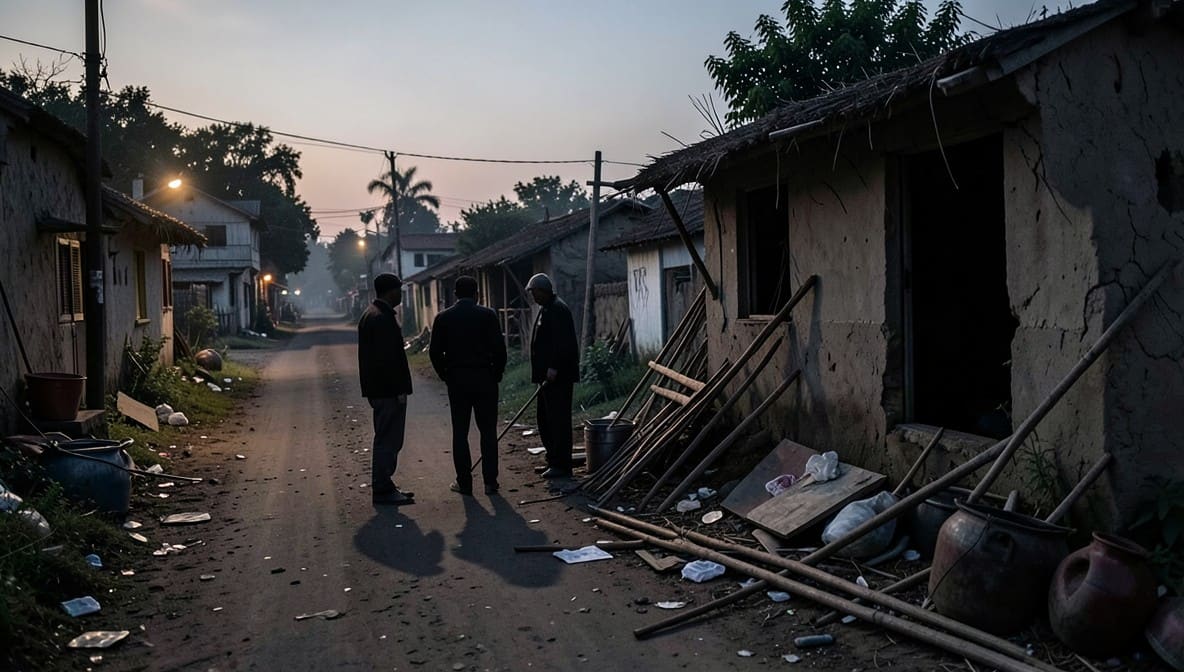
The Court examined the nature of the allegations and the procedural posture of the case. It noted that the alleged incident, even if accepted as true, occurred within the private premises of the accused and followed a commercial dispute over a tractor purchase. The Court observed that the SC/ST Act is intended to address acts of violence, humiliation, or discrimination committed in public or in a manner that reinforces caste-based oppression. The fact that the alleged abuse occurred during a private panchayati meeting and within a home, rather than in a public or institutional setting, weakened the prima facie applicability of Section 3(i)(x) of the Act.
"The occurrence was not in public view and arose out of a commercial transaction, which casts serious doubt on the motive behind the invocation of the SC/ST Act."
The Court further highlighted the significant delay of 78 days between the alleged incident and the filing of the FIR. Such delay, in the absence of any reasonable explanation, raises a legitimate inference of mala fide or fabrication. The Court also noted that the appellants had no criminal antecedents and were willing to cooperate with the investigation.
The Court distinguished this case from those involving overt caste-based violence in public spaces or institutional settings, where the presumption of atrocity is stronger. Here, the facts pointed to a civil dispute that had been criminalized.
The Verdict
The appeal was allowed. The Patna High Court set aside the order dated 01.05.2025 rejecting anticipatory bail. The appellants are granted anticipatory bail for a period of six weeks from the date of receipt of this order. They shall be released on furnishing a personal bond of Rs.5,000 with two sureties of the like amount each, subject to the conditions under Section 482(2) of the Bharatiya Nagarik Suraksha Sanhita, 2023. The appellants must surrender before the trial court and cooperate fully with the investigation.
What This Means For Similar Cases
Delayed FIR Under SC/ST Act Undermines Prima Facie Case
- Practitioners must challenge the invocation of the SC/ST Act where the FIR is filed after a delay exceeding 60 days without credible justification
- Courts are likely to view such delays as indicative of mala fide intent or fabrication, especially in cases involving private disputes
Private Disputes Cannot Be Criminalized Under SC/ST Act
- Allegations arising from commercial transactions, even if accompanied by caste-based slurs, must be evaluated for public context and intent
- The SC/ST Act is not a tool for resolving civil disputes; courts must scrutinize whether the act was committed in a manner that perpetuates caste-based humiliation in public or institutional spheres
Anticipatory Bail Is Not Automatically Denied in SC/ST Cases
- Clean antecedents and willingness to cooperate with investigation are material factors
- Courts must balance the seriousness of the statute with the factual matrix; blanket denial of bail without examining context violates Article 21