The Punjab & Haryana High Court has clarified that secured creditors cannot rely on "as is where is" clauses to evade statutory obligations under the SARFAESI Rules. When a bank misrepresents property details in an auction notice - such as by including non-existent assets or omitting critical land identifiers - it violates its duty to ensure transparency, rendering the auction void and entitling the bidder to a refund of earnest money with interest.
Background & Facts
The Dispute
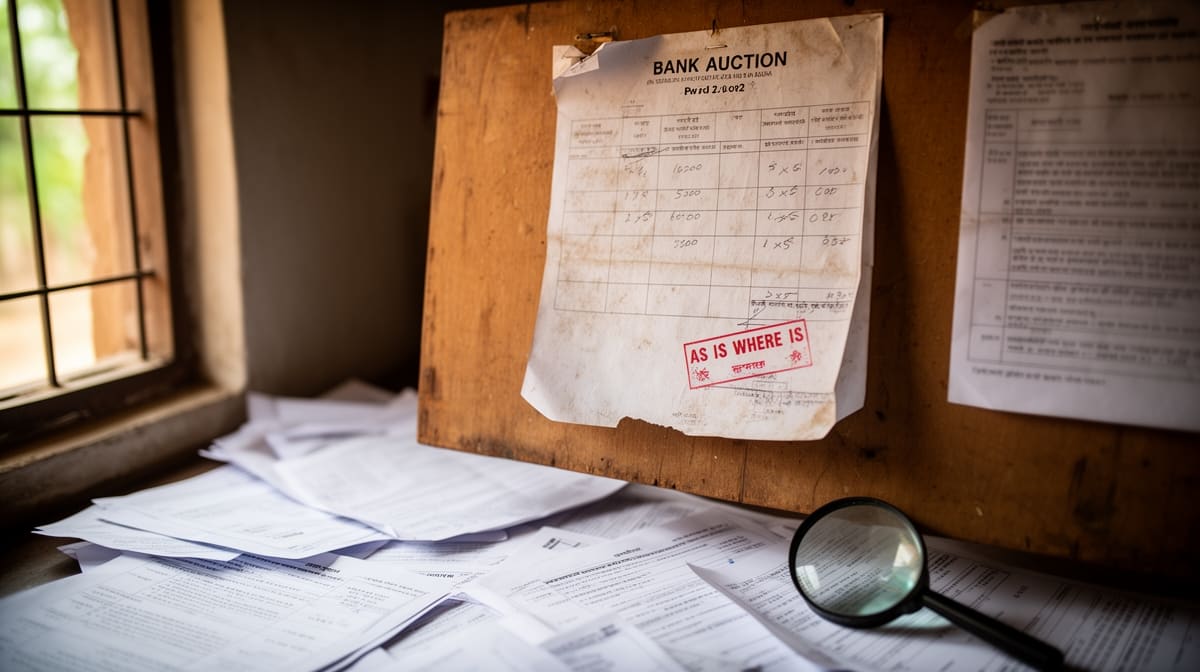
The petitioner, a private bidder, participated in an auction conducted by the Bank of India under the Securitisation and Reconstruction of Financial Assets and Enforcement of Security Interest Act, 2002 (SARFAESI Act). The auction, notified on 19.04.2022, offered two lots: Lot No.1 comprising freehold and leasehold factory land measuring 10 Kanal 8 Marla 3 Sershai in Ferozepur, and Lot No.2 comprising plant and machinery of a Rice Sheller and Flour Mill. The petitioner inspected the property on 26.05.2022, during which Bank officials showed him a single complex bounded by a common wall, including what was represented as a Flour Mill and Rice Sheller machinery located within the mortgaged property. Based on this representation, the petitioner bid successfully on 30.05.2022 and deposited 25% of the bid amount as earnest money.
Key Facts
- The auction notice (Annexure P-1) dated 19.04.2022 listed Lot No.2 as "Plant and Machinery of Rice Sheller and Flour Mill"
- The petitioner conducted a physical inspection on 26.05.2022, during which Bank officials indicated the entire complex - including the Flour Mill - was part of the mortgaged property
- The petitioner deposited 25% of the bid amount on 30.05.2022 (Annexure P-2)
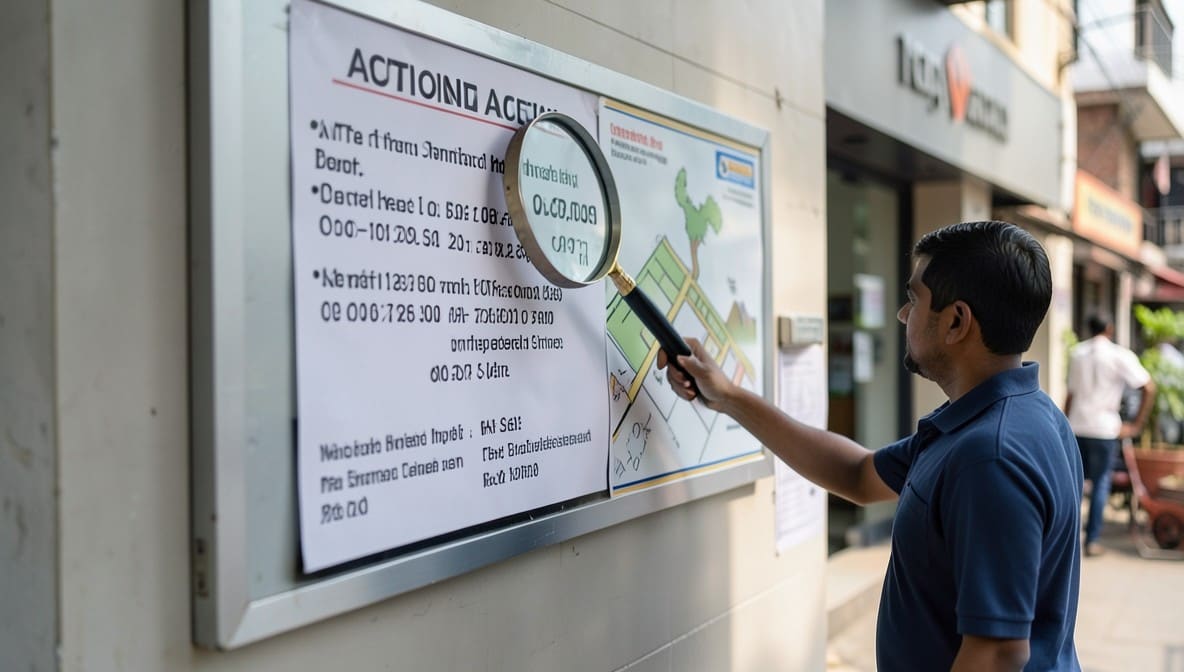
- On 11.08.2022, the petitioner discovered through a revenue sketch map (Annexure P-3) that:
- The Rice Sheller machinery was installed in Khasra No. 20/1 and 22/1/2, which were not mortgaged to the Bank
- No Flour Mill existed on the mortgaged property
- The mortgaged and unmortgaged portions shared a single boundary wall with no demarcation
- The petitioner sent a formal representation (Annexure P-6) on 11.08.2022 seeking clarification
- The Bank extended the deposit deadline to 23.08.2022 under Rule 9(4) of the SARFAESI Rules, 2002
- The Bank claimed Khasra numbers were communicated via WhatsApp to the petitioner’s mobile number 9216992313 on 21.05.2022, but no documentary proof was submitted
- The petitioner’s financial capacity to pay the balance was evidenced by his bank statement (Annexure P-7)
Procedural History
- 19.04.2022: Auction notice published by Bank of India
- 26.05.2022: Physical inspection of property conducted by petitioner with Bank officials
- 30.05.2022: Auction held; petitioner declared successful bidder; deposited 25% earnest money
- 11.08.2022: Petitioner sent representation (Annexure P-6) to Bank highlighting discrepancies
- 23.08.2022: Deadline for balance payment expired; petitioner did not deposit remaining 75%
- 12.10.2022: Bank issued notice of forfeiture of earnest money
- 15.12.2022: Petitioner filed writ petition (CWP-18624-2022) before Punjab & Haryana High Court
- 22.01.2026: Case reserved for judgment
- 01.04.2026: Judgment pronounced
Relief Sought
The petitioner sought either:
- Direction to the Bank to deliver possession of the entire property as shown during inspection, including the Flour Mill and Rice Sheller machinery; or
- In the alternative, refund of the 25% earnest money deposited with 15% interest per annum from the date of deposit.
The Legal Issue
The central question was whether a secured creditor’s failure to accurately disclose the description of the immovable property - including the absence of a declared asset and omission of Khasra numbers - constitutes a violation of Rule 8(7) of the Security Interest (Enforcement) Rules, 2002, and whether such violation entitles the auction purchaser to a refund of earnest money despite an "as is where is" clause.
Arguments Presented
For the Petitioner
The petitioner’s counsel argued that Rule 8(7) imposes a statutory duty on the secured creditor to disclose all material details of the property, including encumbrances and exact boundaries. The inclusion of a non-existent Flour Mill and omission of Khasra numbers amounted to material misrepresentation. Reliance was placed on Haryana Financial Corporation v. Rajesh Gupta (2010) and Joginder Singh v. Punjab National Bank (2022), which held that "as is where is" does not absolve the bank of its duty to disclose known defects. The petitioner acted in good faith, relying on the Bank’s representations, and the failure to disclose rendered the auction fundamentally flawed.
For the Respondent
The Bank contended that the auction notice clearly stated "as is where is" and that the petitioner had inspected the property before bidding. It argued that the mention of the Flour Mill was an inadvertent clerical error and that Khasra numbers were communicated via WhatsApp. The Bank asserted that the petitioner’s delay in raising objections until after the deposit deadline indicated bad faith and that forfeiture of earnest money was justified under the terms of the auction.
The Court's Analysis
The Court examined Rule 8(7) of the SARFAESI Rules, 2002, which mandates that the notice of sale must include "the description of the immovable property to be sold, including the details of the encumbrances known to the secured creditor" and "any other terms and conditions which the authorized officer considers necessary for a purchaser to know the nature and value of the property."
"The bank cannot shrug off its responsibility in disclosing the encumbrances in the advertisement when it is known that transparency is the essence of good governance and fair play."
The Court noted that the Bank admitted the Flour Mill did not exist and that Khasra numbers were not included in the auction notice. The claim of WhatsApp communication lacked corroboration - no evidence was produced to establish that the number belonged to the petitioner or that the message was received. The Court emphasized that the duty under Rule 8(7) is not contractual but statutory, and cannot be waived by a blanket "as is where is" clause.
The Court distinguished Rakesh Kumar Kaushal v. State of U.P. and affirmed the principle from Mandava Krishna Chaitanya v. UCO Bank that the doctrine of caveat emptor has been superseded by caveat vendor in modern banking transactions. The Bank, as a public financial institution, owes a duty of transparency to prospective buyers. The failure to disclose the true status of the property - particularly the fact that key machinery was located on unmortgaged land and a declared asset was non-existent - rendered the auction process defective and unfair.
The Court further held that the absence of demarcation between mortgaged and unmortgaged land, coupled with the misrepresentation of assets, made physical delivery of the entire property as represented impossible. Therefore, the primary relief of possession could not be granted.
The Verdict
The petition was allowed in part. The Court directed the Bank of India to refund 25% of the bid amount deposited by the petitioner as earnest money, with interest at 9% per annum from the date of deposit, within two months from the date of judgment. The Bank was also directed to pay costs of ₹25,000 to the petitioner. The Court explicitly held that the auction was vitiated due to violation of Rule 8(7) and that the "as is where is" clause could not shield the Bank from its statutory obligations.
What This Means For Similar Cases
Disclosure Obligations Under SARFAESI Are Non-Negotiable
- Practitioners must now argue that any omission of Khasra numbers, misstatement of assets, or failure to disclose encumbrances in auction notices constitutes a breach of Rule 8(7)
- Banks cannot rely on "as is where is" disclaimers to avoid liability for material misrepresentations
- Petitioners in similar cases should immediately obtain revenue maps and file representations upon discovering discrepancies
Earnest Money Refund Is a Statutory Remedy, Not a Contractual One
- Refund of earnest money is not a discretionary remedy but a legal consequence of statutory non-compliance
- Interest at 9% per annum is now a recognized standard for such refunds in the absence of a higher contractual rate
- Courts will not permit forfeiture of earnest money when the secured creditor’s own negligence or misrepresentation caused the buyer’s withdrawal
Due Diligence by Banks Must Be Documented
- Banks must maintain verifiable records of all disclosures made to bidders, including WhatsApp messages, emails, or site visit reports
- Oral assurances during inspections are insufficient; all material information must be included in the auction notice or uploaded to the bank’s website
- Failure to document disclosures will result in adverse inference against the bank in litigation