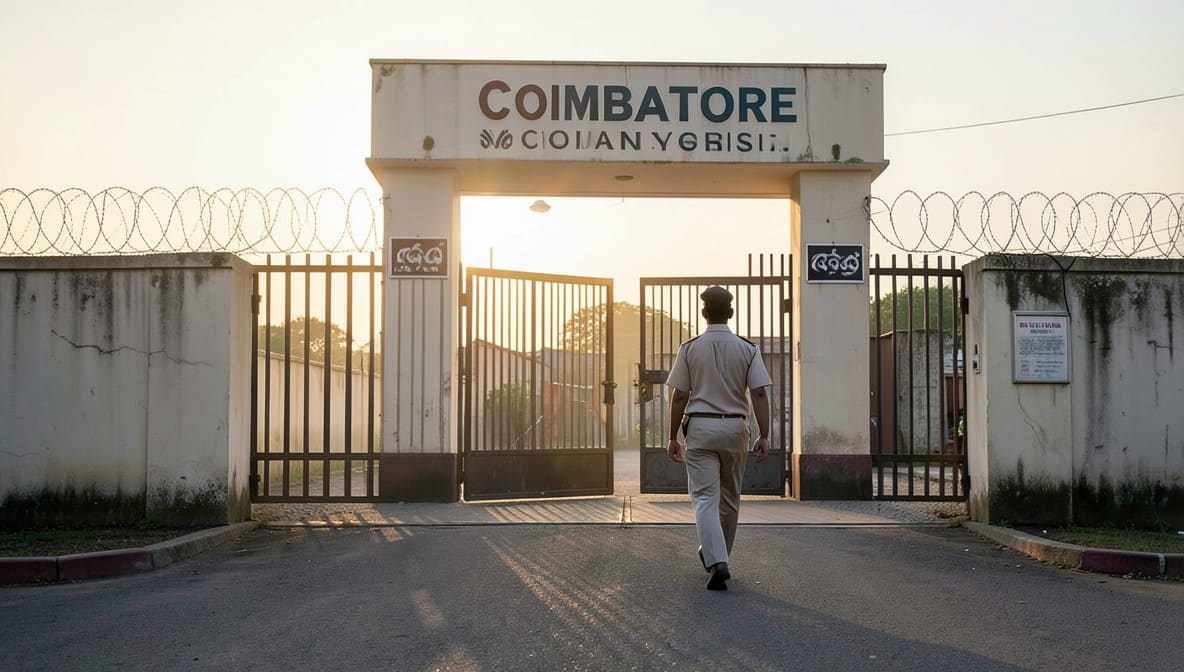
The Madras High Court has reaffirmed that undue delay in deciding representations for premature release of convicts on medical grounds violates the fundamental right to fair procedure. In a case involving a life convict with total visual disability, the Court condemned administrative inaction despite a prior judicial direction, and imposed a strict timeline for decision-making.
Background & Facts
The Dispute
The petitioner, M. Gowthaman, filed this writ petition under Article 226 of the Constitution seeking the immediate release of his father, Mr. Murugesan S/o. Kanniyappan, a convict serving a life sentence in Central Prison, Coimbatore. The petitioner contends that his father suffers from 100% visual disability, rendering him eligible for premature release under Rule 631 of the Tamil Nadu Prison Rules, 2024.
Key Facts
- Mr. Murugesan was sentenced to life imprisonment by an order dated 05.03.2025
- He is identified as Convict Prisoner with PID No. 71997
- The petitioner submitted a representation for premature release on medical grounds on 10.11.2025
- The representation was pending without any substantive decision as of the filing of this petition
- The petitioner had previously approached the Court in W.P. No. 1658 of 2025
Procedural History
- 10.11.2025: Representation for premature release submitted by petitioner on behalf of convict
- 15.12.2025: High Court issued direction in W.P. No. 1658 of 2025 to respondents to consider the representation on merits and in accordance with law
- Post-15.12.2025: Authorities conducted a medical assessment by sending the convict to a Government hospital and before a Medical Board
- No decision: Despite medical evaluation, no order was passed on the representation
- 29.04.2026: Present writ petition filed seeking mandamus for immediate release
Relief Sought
The petitioner seeks a writ of mandamus directing the respondents to release Mr. Murugesan immediately on medical grounds, citing Rule 631 of the Tamil Nadu Prison Rules, 2024, and the complete loss of vision.
The Legal Issue
The central question was whether the authorities’ failure to decide a representation for premature release on medical grounds, despite a prior judicial direction, constitutes a violation of natural justice and procedural fairness under Article 21 of the Constitution.
Arguments Presented
For the Petitioner
The petitioner’s counsel, Mr. P. Pugalenthi, argued that the convict’s 100% visual disability qualifies him for premature release under Rule 631 of the Tamil Nadu Prison Rules, 2024. He emphasized that the representation dated 10.11.2025 had been pending for over five months, and the authorities had merely conducted a medical assessment without taking any decision. He relied on the Court’s earlier order dated 15.12.2025, which had already directed consideration of the representation, and contended that further delay amounted to a denial of justice.
For the Respondent
The Additional Public Prosecutor, Mr. R. Muniyapparaj, did not contest the factual assertions regarding the convict’s medical condition or the pendency of the representation. He acknowledged the medical evaluation had been completed but offered no justification for the delay in decision-making.
The Court's Analysis
The Court observed that the representation for premature release had been pending since November 2025, and despite a clear direction from this Court on 15.12.2025 to consider the matter on merits, no decision had been rendered. The authorities had fulfilled only a part of their obligation - conducting a medical assessment - but had failed to evaluate the findings in light of Rule 631, relevant Government orders, and the convict’s overall circumstances.
"The authorities ought not to have tarried thus far, forcing the petitioner to approach this Court yet again."
The Court held that the right to life under Article 21 includes the right to humane treatment and procedural fairness, even for convicts. Delay in deciding representations for medical parole or premature release, particularly when a prior judicial direction exists, amounts to a breach of natural justice. The Court noted that Rule 631 of the Tamil Nadu Prison Rules, 2024, provides a clear framework for such considerations, and administrative inertia cannot override statutory and constitutional obligations.
The Court rejected the notion that medical evaluation alone suffices. Decision-making requires application of law to facts, and the failure to do so renders the process incomplete and arbitrary.
The Verdict
The writ petition was disposed of with the direction that the respondents shall consider the representation dated 10.11.2025, along with the medical assessment report, applicable Government orders, and Rule 631 of the Tamil Nadu Prison Rules, 2024, and pass a reasoned order within four weeks from the date of receipt of a copy of this order. The petition is dismissed as disposed of.
What This Means For Similar Cases
Procedural Delay Is a Violation of Natural Justice
- Practitioners must now treat any delay beyond a reasonable period in deciding medical parole or premature release applications as a ground for writ relief
- A prior judicial direction to decide a representation creates a binding obligation; non-compliance invites contempt proceedings
- Medical assessment alone is insufficient - there must be a formal, reasoned order applying the relevant rules
Rule 631 of TN Prison Rules 2024 Is a Living Right
- Rule 631 is not a discretionary privilege but a procedural safeguard for disabled convicts
- Any claim under Rule 631 must be evaluated within a reasonable timeframe, especially when supported by conclusive medical evidence
- Failure to decide within a reasonable period shifts the burden to the State to justify the delay
Writ Jurisdiction Is Available for Administrative Inaction
- Courts will not tolerate passive compliance with judicial orders
- Writ of mandamus is an appropriate remedy when authorities fail to act despite clear legal obligations
- Petitioners should cite prior judicial directions as evidence of bad faith or negligence in administrative processes