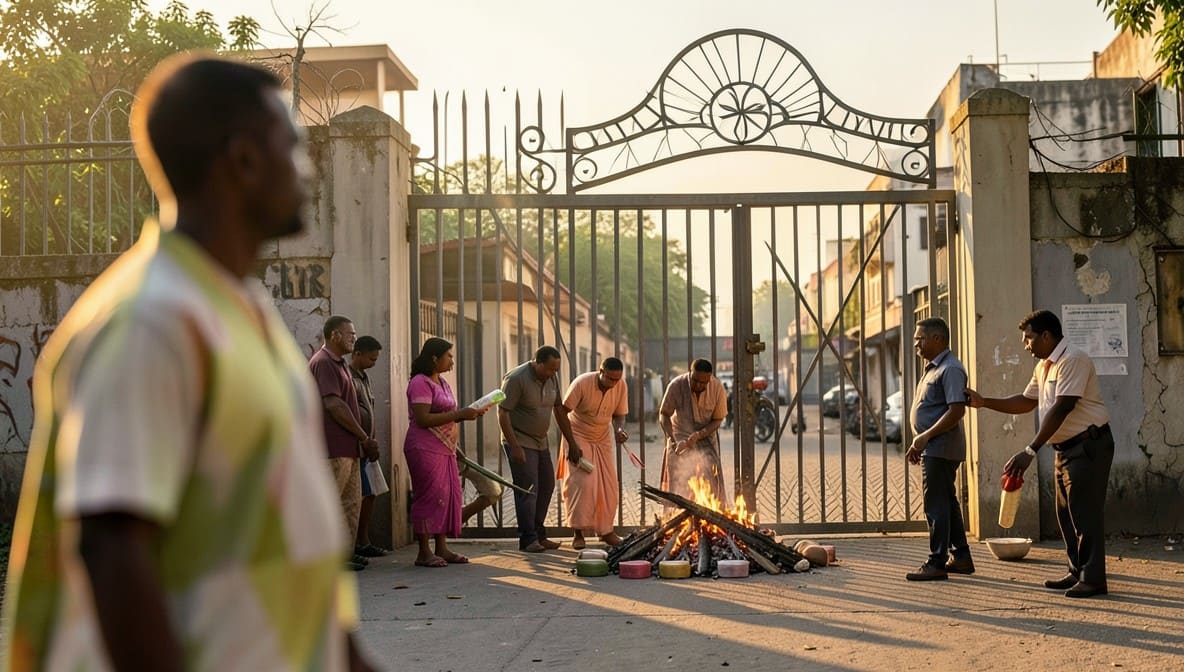
In a compassionate yet legally nuanced order, the Madras High Court has directed prison authorities to reconsider a plea for emergency leave sought by a life convict to perform the 15th and 16th day rituals following his father’s demise. While Rule 6 of the Tamil Nadu Suspension of Sentence Rules, 1982 does not explicitly cover such ceremonies, the Court invoked Rule 40, which grants discretionary power to exempt prisoners from the Rules, underscoring the balance between statutory rigidity and humanitarian considerations in prison administration.
Background & Facts
The Dispute
The petitioner, M. Malar, is the mother of two life convicts - Arun and Sathish - confined in Central Prison, Puzhal, Chennai. Her husband, Munusamy @ Madhan, passed away during the convicts’ incarceration. While Arun was granted one day of emergency leave to perform the death rituals, the petitioner sought an additional four days of unescorted emergency leave for both sons to attend the 15th and 16th day ceremonies, scheduled for 04.05.2026 and 05.05.2026. The request was rejected on the ground that Rule 6 of the Tamil Nadu Suspension of Sentence Rules, 1982 does not provide for such leave.
Key Facts
- The petitioner’s husband, Munusamy @ Madhan, died during the convicts’ imprisonment
- Arun was granted one day of emergency leave to perform the death rituals
- The petitioner sought four days of unescorted emergency leave for both sons to attend the 15th and 16th day ceremonies
- The ceremonies were scheduled for 04.05.2026 and 05.05.2026
- The request was made via a representation dated 23.04.2026
- The convicts are identified by Prisoner ID Nos. 102888 (Arun) and 72276 (Sathish)
Procedural History
- 23.04.2026: Petitioner filed a representation seeking emergency leave for the convicts
- Rejection: The request was denied on the ground that Rule 6 does not cover 15th and 16th day rituals
- 29.04.2026: Petitioner filed WP Crl. No. 1069 of 2026 under Article 226 of the Constitution before the Madras High Court
Relief Sought
The petitioner sought a Writ of Mandamus directing the respondents to:
- Grant four days of unescorted emergency leave to the convicts
- Allow the convicts to perform the 15th and 16th day rituals of their deceased father
The Legal Issue
The central question before the Court was whether Rule 6 of the Tamil Nadu Suspension of Sentence Rules, 1982 permits the grant of emergency leave for rituals beyond the explicitly enumerated grounds, and if not, whether Rule 40 - which empowers authorities to exempt prisoners from the Rules - could be invoked to accommodate such requests.
Arguments Presented
For the Petitioner
The petitioner contended that:
- The denial of leave for the 15th and 16th day rituals was arbitrary and inhumane
- While Rule 6 does not explicitly cover such ceremonies, the authorities should exercise discretion under Rule 40 to grant leave on humanitarian grounds
- The convicts had already been granted leave for the death rituals, justifying an extension for the subsequent ceremonies
For the Respondent
The respondents, represented by the Additional Public Prosecutor, argued that:
- Rule 6 exhaustively lists the grounds for emergency leave, and the 15th and 16th day rituals are not included
- Granting leave beyond the statutory grounds would set a precedent and undermine the rigidity of prison rules
- The petitioner’s request was not covered under any provision of the Rules, and thus, the rejection was justified
The Court's Analysis
The Court acknowledged that Rule 6 of the Tamil Nadu Suspension of Sentence Rules, 1982 enumerates specific grounds for emergency leave, none of which include the 15th and 16th day rituals. The Court observed:
"Admittedly, the performance of 15th and 16th day ceremony is not one of the aforesaid circumstance. Hence, we are not persuaded to amplify the ambit of Rule 6 and in such circumstances, we find nothing untoward in the rejection of the petitioner’s plea."
However, the Court noted that Rule 40 confers discretionary power on prison authorities to exempt prisoners from the Rules in exceptional circumstances. Given that:
- The convict’s father’s death was not disputed
- The convict had already been granted emergency leave for the death rituals
- The rituals in question were culturally significant and time-bound
The Court directed the respondents to reconsider the petitioner’s plea under Rule 40, emphasizing that any leave granted should be restricted to the 15th and 16th day ceremonies and accompanied by adequate escort measures at the State’s cost.
The Verdict
The Court disposed of the writ petition with the following directions:
- The respondents must reconsider the petitioner’s representation dated 23.04.2026 under Rule 40 of the Tamil Nadu Suspension of Sentence Rules, 1982
- The exercise must be completed within one day from 29.04.2026
- The result must be promptly intimated to the petitioner and the convicts
- If leave is granted, it shall be restricted to 04.05.2026 and 05.05.2026 (the dates of the ceremonies)
- The State shall bear the cost of escort measures to ensure compliance
What This Means For Similar Cases
Discretionary Powers Under Rule 40: A Safety Valve for Humanitarian Considerations
- Rule 40 serves as a critical exception to the rigidity of Rule 6, allowing prison authorities to address circumstances not explicitly covered by the statute
- Practitioners should argue for the invocation of Rule 40 in cases involving culturally significant or time-bound rituals, even if they fall outside the enumerated grounds
- Courts may be inclined to direct reconsideration where prior leave was granted for a related event (e.g., death rituals), as it establishes a precedent for accommodation
Limits of Statutory Enumeration: When Rules Fall Short
- Rule 6 is exhaustive, and courts are generally reluctant to expand its ambit through judicial interpretation
- However, where humanitarian or cultural considerations are compelling, Rule 40 provides a legal pathway for relief
- Prison authorities must balance statutory compliance with compassion, particularly in cases involving family bereavement or religious obligations
Procedural Safeguards: Escort and Cost Implications
- Any leave granted under Rule 40 must include adequate escort measures, the cost of which shall be borne by the State
- Practitioners should emphasize the temporary and restricted nature of the leave sought to allay concerns about misuse
- Courts may impose strict timelines for compliance, as seen in this case (one day for reconsideration)