The Bombay High Court has reaffirmed that quasi-judicial authorities under the Maharashtra Ownership of Flats Act, 1963 cannot revisit and reverse their own final orders on deemed conveyance merely because an applicant refines the area claimed. The judgment establishes that res judicata applies with full force to such proceedings, preventing multiplicity of litigation and protecting settled proprietary rights.
Background & Facts
The Dispute
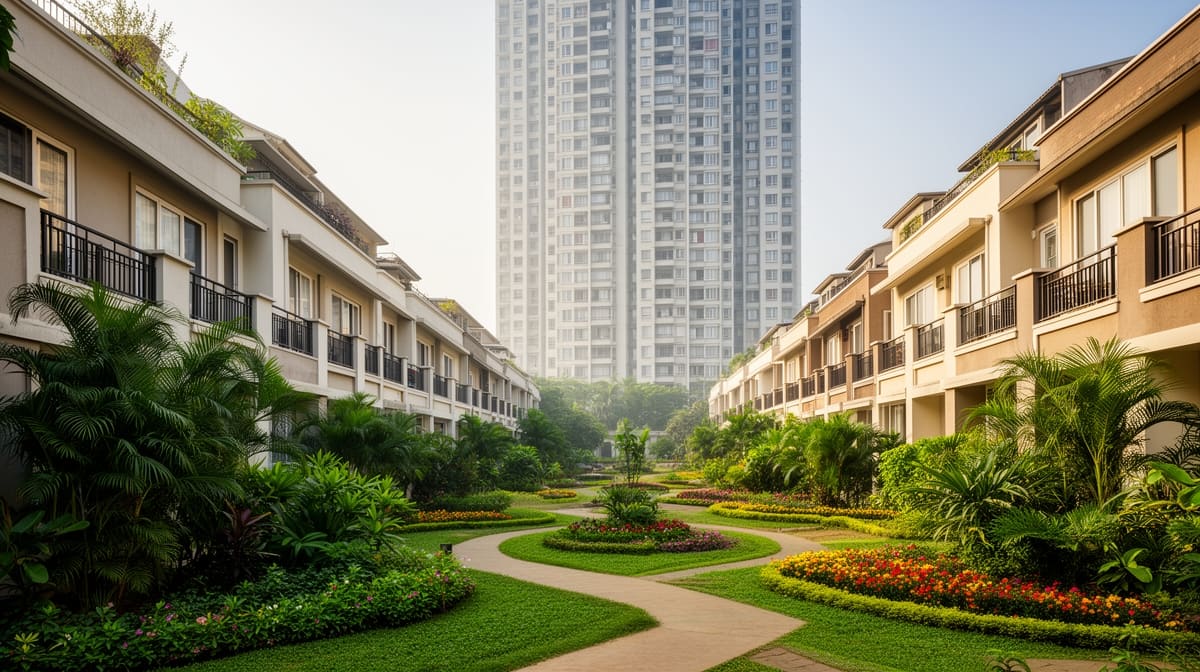
The dispute centers on the allocation of land within a composite development at Lokhandwala, Mumbai, comprising three cooperative housing societies - Magnum Unit A, Magnum Unit B, and Magnum Tower CHS Limited. The Petitioners, representing the first two societies, have been in peaceful possession of their row houses and appurtenant garden areas for over thirty-five years. The Developer, Lokhandwala Estate & Development Company Ltd., constructed Magnum Units A and B first, utilizing only a portion of the total 13,569 sq. mtrs. plot. The residual Floor Space Index was later used to build Magnum Tower, which is owned by Respondent No. 3. The Petitioners assert that the land allocated to Magnum Tower includes garden areas and common access roads exclusively granted to them under unregistered Package Deal Agreements.
Procedural History
The matter has undergone two distinct adjudications before the District Deputy Registrar:
- 2017: Respondent No. 3 filed Application No. 39 of 2016 seeking deemed conveyance of the entire 13,569 sq. mtrs. plot. The application was rejected on merits on 24 January 2017, with the authority holding that inclusion of common areas would prejudice the rights of other societies.
- 2023: Respondent No. 3 filed a fresh application (No. 63 of 2022) seeking conveyance of 10,097.84 sq. mtrs. - a figure nearly identical to the 10,160.81 sq. mtrs. previously rejected. The same authority granted the application on 9 January 2023, issuing a certificate under Section 11 of the Maharashtra Ownership of Flats Act.
Relief Sought
The Petitioners sought quashing of the 2023 order and certificate, arguing that the authority had violated the doctrine of res judicata by reconsidering a matter already finally decided. They further contended that the order ignored contractual rights, violated procedural mandates under the 2018 Government Resolution, and improperly included common amenities.
The Legal Issue
The central question was whether a quasi-judicial authority, having finally rejected an application for deemed conveyance under Section 11 of the Maharashtra Ownership of Flats Act, can later grant a substantially similar application on the same cause of action, merely by adjusting the area claimed.
Arguments Presented
For the Petitioner
Senior Advocate Girish Godbole argued that the 2017 order was a final adjudication on merits, not a procedural dismissal. The authority had explicitly rejected the claim due to inclusion of common areas - precisely the same grounds raised in the 2023 application. Reliance was placed on Faime Makers Private Ltd. v. District Deputy Registrar (2025) 5 SCC 772 and M/s. Aakansha Construction Co. v. State of Maharashtra to establish that res judicata binds quasi-judicial authorities. The Petitioners emphasized that the 2023 order ignored Clause 6(b) of the Package Deal Agreement and Clause 4 of the Supplementary Agreement, which conferred exclusive garden rights. They also highlighted the authority’s failure to appoint an independent architect under the 2018 Government Resolution, as required when measurement disputes arise.
For the Respondent
Advocate Sachin Mandlik contended that the 2023 application was not a repetition but a distinct claim, as it sought conveyance of a specific portion (10,097.84 sq. mtrs.) rather than the entire plot. He argued that the 2017 order was based on procedural and evidentiary deficiencies, not a final determination of entitlement. He relied on the registered MOFA agreements, which allegedly recorded Respondent No. 3’s entitlement to 13,282.20 sq. mtrs., and asserted that unregistered agreements could not override them. He further submitted that the Competent Authority’s role is limited to statutory compliance and cannot adjudicate complex title disputes, which must be resolved in civil court.
The Court's Analysis
The Court undertook a rigorous doctrinal analysis of res judicata in quasi-judicial proceedings, drawing extensively from Sajjadanashin Sayed v. Musa Dadabhai Ummer (2000) 3 SCC 350 and Faime Makers. It held that the doctrine applies with equal force to proceedings under Section 11 of the Maharashtra Ownership of Flats Act, as the District Deputy Registrar acts as a quasi-judicial authority when hearing rival claims, examining documents, and recording reasoned orders.
"The law does not permit a party to split its claims or hold back part of its case and then attempt to agitate it later in a fresh proceeding."
The Court emphasized that the test for res judicata is not formalistic but substantive: whether the core issue was directly and substantially in issue in the prior proceeding. In the 2017 order, the authority had examined whether Respondent No. 3 was entitled to conveyance of land including common areas - a finding that formed the very foundation of its rejection. The 2023 application, despite a marginal numerical adjustment, sought the same relief on the same factual basis. The Court observed:
"Merely fragmenting the relief, or presenting it in a slightly altered form, does not create a new cause of action. The law looks at the real nature of the dispute, not the label attached to it."
The Court rejected the Respondent’s argument that unregistered agreements were irrelevant, noting that the 2017 order had already considered contractual rights and found them incompatible with unilateral conveyance of common areas. It further held that the authority’s failure to follow the mandatory procedure under the 2018 Government Resolution - by not appointing an independent architect - rendered the 2023 order procedurally invalid.
The Court distinguished between issues directly in issue (statutory entitlement to conveyance) and collateral matters (title disputes, contractual interpretations), but concluded that the 2017 order had definitively resolved the former. No jurisdictional defect or material change in facts justified reopening.
The Verdict
The Petitioners won. The Bombay High Court held that the District Deputy Registrar’s 2023 order granting deemed conveyance violated the doctrine of res judicata, as it reopened a matter finally decided in 2017. The impugned order and certificate under Section 11 of the Maharashtra Ownership of Flats Act were quashed. The Court directed Respondent No. 3 to pursue any substantive claims in civil court, with a directive for expeditious disposal within one year.
What This Means For Similar Cases
Res Judicata Applies to Deemed Conveyance Proceedings
- Practitioners must treat final orders under Section 11 MOFA as binding, even if erroneous, unless set aside in appeal or writ
- A fresh application with a modified area claim does not circumvent res judicata if the underlying cause of action remains identical
- Authorities must record clear findings on whether entitlement was denied on merits or procedure
Common Areas Cannot Be Conveyed Without Consent
- Garden areas, access roads, and recreational spaces designated for exclusive use by one society cannot be included in conveyance to another without clear contractual or statutory basis
- Competent Authorities must scrutinize agreements and reject conveyance if it prejudices existing possessory rights
Procedural Compliance Is Non-Negotiable
- Where Government Resolutions mandate independent architectural verification in disputed layouts, non-compliance vitiates the order
- Reliance on a single architect’s certificate, especially when contested, without independent verification, is legally unsustainable
- Practitioners must raise procedural non-compliance as a ground for challenge, not merely substantive disagreement