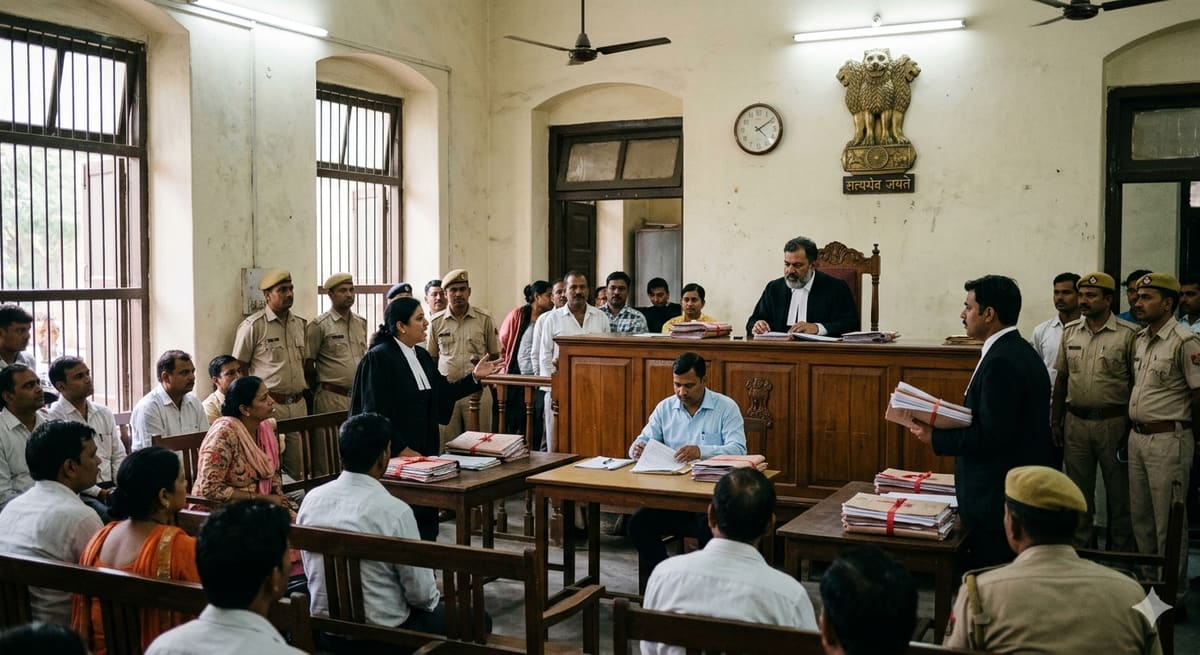
The Gauhati High Court has clarified that conviction under Section 4 of the POCSO Act requires proof of actual penetration, and where such proof is absent, the accused may still be convicted for attempt to commit penetrative sexual assault under Section 18 read with Section 4(2). This judgment reinforces the distinction between completed and attempted offences under child protection law, ensuring proportionate sentencing based on evidentiary thresholds.
Background & Facts
The Dispute
The appellant, Bijay Das, was charged with committing penetrative sexual assault on a 13-year-old girl, his neighbour’s daughter, on the night of 06.04.2021. The prosecution alleged that he trespassed into the victim’s home, set fire to the dwelling, and took the victim to his house where he attempted to rape her. The victim’s mother, Chitra Das, filed an FIR on 07.04.2021 with the Matia Police Station, leading to the registration of Case No. 76/2021 under Sections 427, 379, 366A, 376 IPC and Section 4 of the POCSO Act.
Key Facts
- The victim, PW-3, was born on 21.11.2007, making her 13 years and 5 months old at the time of the incident on 06.04.2021
- The appellant had a prior history of harassing and beating the victim’s mother
- On the night of the incident, the appellant chased the mother with a dao, prompting her to flee
- The appellant set fire to the victim’s house, destroying personal belongings including the victim’s school books and birth certificate
- The victim emerged from hiding to retrieve her books, whereupon the appellant grabbed her, gagged her mouth, took her to his house, undressed her, and attempted to insert his penis into her vagina
- The victim resisted and escaped when the appellant fell asleep
- The victim’s hymen was found torn during medical examination on 07.04.2021, but no signs of recent sexual activity were detected
- The victim’s testimony under Section 164 CrPC stated the appellant attempted full insertion but failed due to her resistance; this was not reiterated in court
- The appellant did not cross-examine the victim on her age or the sequence of events
Procedural History
- 06.04.2021: Alleged incident occurred
- 07.04.2021: FIR filed by victim’s mother at Matia Police Station
- 07.04.2021: Case No. 76/2021 registered under Sections 427/379/366A/376 IPC and Section 4 POCSO Act
- 15.06.2021: Investigation completed; charge-sheet filed by SI Hafiz Ali Saikia
- 20.07.2021: Five charges framed under Sections 448/427/342/376 IPC and Section 4 POCSO Act
- 04.02.2023: Special Judge, Goalpara convicted appellant under Sections 448/342 IPC and Section 4 POCSO Act; sentenced to 20 years RI with Rs. 20,000 fine under POCSO, plus 2 months RI each under Sections 448 and 342 IPC (concurrent)
- 31.03.2023: Appeal filed before Gauhati High Court
- 31.03.2026: Judgment delivered by Division Bench
The Parties' Positions
For the Appellant
- Argued that no evidence proved penetration of the victim’s vagina by the appellant’s penis
- Contended that the victim’s testimony only established an attempt, not completion, of penetrative sexual assault
- Highlighted that the medical report showed no recent sexual activity, only a torn hymen
- Asserted that the Section 164 CrPC statement could not be used as substantive evidence for conviction
- Disputed the reliability of the victim’s age claim, though no cross-examination was conducted
For the Respondent
- Argued that the victim’s testimony, corroborated by the torn hymen and the appellant’s conduct, established penetrative sexual assault
- Maintained that the Trial Court correctly applied Section 4 POCSO Act
- Stated that the victim’s account was consistent and credible
- Opposed any alteration of charge, asserting the conviction was legally sound
Relief Sought
The appellant sought: (1) quashing of conviction under Section 4 POCSO Act; (2) reduction or alteration of sentence to reflect attempt rather than completion of penetrative sexual assault; (3) setting aside of the 20-year sentence; and (4) recognition that the conviction under Sections 448 and 342 IPC was valid.
The Legal Issue
The central question was whether the appellant’s conduct, as established by the victim’s testimony, amounted to penetrative sexual assault under Section 4 of the POCSO Act, or whether it constituted only an attempt to commit such an offence under Section 18 read with Section 4(2) of the Act.
Arguments Presented
For the Appellant
The appellant’s counsel relied on the victim’s testimony that the appellant "tried to insert his penis into her vagina but could not succeed" and emphasized that Section 3 of the POCSO Act requires actual penetration for a conviction under Section 4. Citing R Shaji v. State of Kerala (2013) 14 SCC 266, counsel argued that a Section 164 CrPC statement cannot serve as substantive evidence and was not repeated in court, rendering it inadmissible for conviction. Counsel further contended that the medical evidence showed no recent sexual activity, undermining the prosecution’s claim of penetration. The absence of any corroboration for penetration, coupled with the victim’s own admission of failure, rendered Section 4 inapplicable.
For the Respondent
The State argued that the victim’s account, the torn hymen, and the appellant’s violent conduct collectively established penetrative sexual assault. The Additional Public Prosecutor maintained that the Trial Court’s finding was based on a holistic appreciation of evidence and that the victim’s testimony was credible and unimpeached. The State contended that the medical report’s silence on recent sexual activity did not negate penetration, as the examination occurred hours after the incident. The prosecution further argued that the appellant’s actions were consistent with the definition of penetrative sexual assault under Section 3.
The Court's Analysis
The Court undertook a meticulous analysis of Section 3 of the POCSO Act, which defines penetrative sexual assault as including "penetration of the penis to any extent in the vagina, mouth, urethra or anus of a child." The Court noted that the victim’s testimony in court explicitly stated that the appellant "made attempt to commit rape" and "could not succeed" in inserting his penis. This was consistent with her earlier Section 164 CrPC statement, which the Court held could not be used as substantive evidence under R Shaji v. State of Kerala.
"When the victim has not given any evidence to prove that there was penetration into her private parts by the private parts of the appellant, there is no question of attracting the provisions of Section 3 of the POCSO Act."
The Court further observed that while the hymen was torn, the medical officer found no signs of recent sexual activity, which cast doubt on the prosecution’s assertion of completed penetration. The Court emphasized that the law requires strict proof of penetration for Section 4, and the absence of such proof precludes conviction under that provision.
However, the Court found that the appellant’s conduct clearly fell within the ambit of Section 7 of the POCSO Act, which criminalizes sexual assault involving physical contact without penetration, and Section 18, which punishes attempts to commit offences under the Act. The Court held that the appellant’s act of attempting to insert his penis into the victim’s vagina, coupled with the physical restraint and undressing, constituted a clear attempt to commit penetrative sexual assault.
The Court invoked Section 216 of the CrPC to alter the charge from Section 4 to Section 4(2) read with Section 18 of the POCSO Act, noting that the defence would not have changed, and no prejudice was caused to the appellant. The Court declined to proceed with a conviction under Section 8 for sexual assault under Section 7, as the attempt charge already encompassed the gravity of the act.
The Verdict
The appellant’s conviction under Section 4 of the POCSO Act was set aside. He was instead convicted under Section 4(2) read with Section 18 of the POCSO Act and sentenced to rigorous imprisonment for 10 years with a fine of Rs. 20,000, in default to undergo simple imprisonment for 4 months. The convictions and sentences under Sections 448 and 342 IPC were upheld. The period of detention already undergone was set off against the new sentence. The Trial Court’s judgment dated 04.02.2023 was modified accordingly.
What This Means For Similar Cases
Attempted Penetrative Sexual Assault Is a Distinct Offence
- Practitioners must now distinguish between completed penetrative sexual assault (Section 4) and attempted penetrative sexual assault (Section 18 read with Section 4(2)) in POCSO cases
- Where penetration is not proved, even if the accused made a clear attempt, Section 18 becomes the appropriate charge
- Medical evidence alone cannot substitute for testimonial proof of penetration
Section 164 CrPC Statements Are Not Substantive Evidence
- Prosecutors must ensure that any incriminating statements made under Section 164 CrPC are reiterated in court testimony
- Relying on Section 164 statements as the sole basis for conviction is legally untenable, as confirmed by R Shaji v. State of Kerala
- Defence counsel should challenge convictions based solely on Section 164 statements
Charge Alteration Under Section 216 CrPC Is Permissible Without Prejudice
- Courts may alter charges under Section 216 CrPC even at the appellate stage if the nature of the offence remains substantially the same
- No need to recall witnesses if the defence would not change and no prejudice is caused
- This provides a procedural safeguard to ensure correct legal classification without retrial