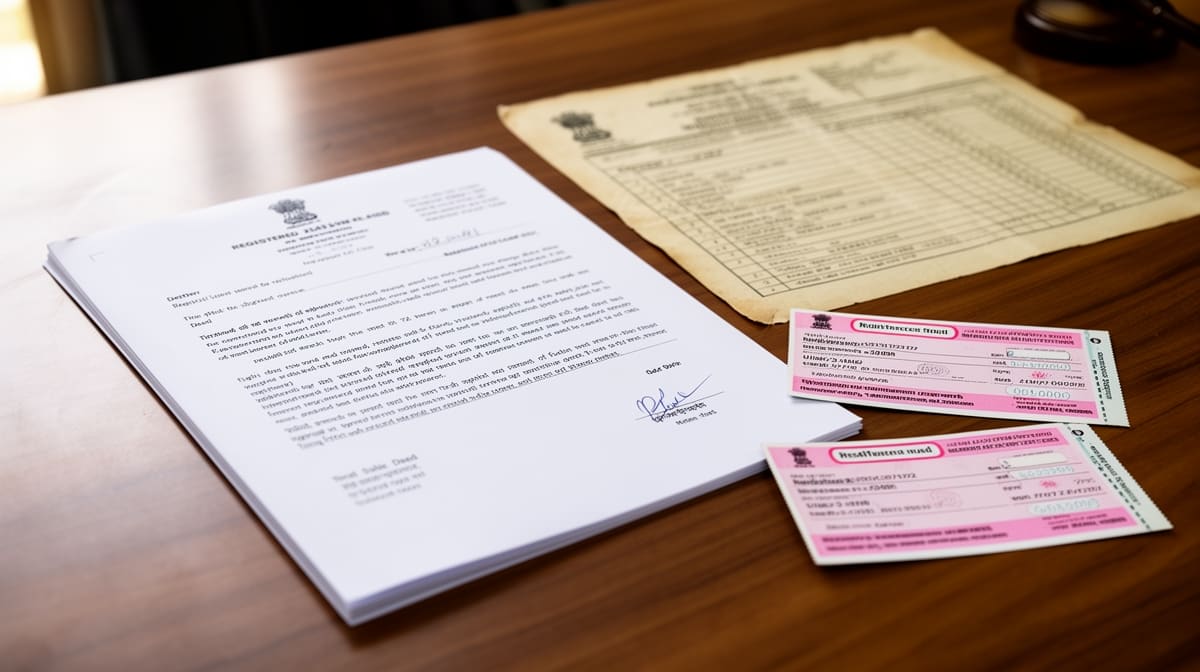
The Delhi High Court dismissed a regular first appeal, upholding the lower court’s decree that a sale deed executed despite incomplete payment of consideration remains valid, and affirmed possession and rent arrears against the defendants.
Background & Facts
The Dispute
The appellant, Ms. Amarjeet Kaur, filed a civil suit (CS DJ 829/2018) seeking declaration that a sale deed dated 02.06.2017, executed by Defendant No.1 in favour of Defendant No.2, was null and void, along with possession, damages and a permanent injunction against the creation of third-party rights over the suit property (Municipal New No. RZ-265, Gali No. 19, New Delhi-110019).
Key Facts
- 12.09.2016: Sale deed executed by Defendant No.1 in favour of the plaintiff for the First, Second and Third Floors with terrace rights, consideration Rs 28,50,000.
- 15.09.2016: Sale deed registered.
- 09.09.2016: Lease agreement executed, registered on 15.09.2016, for the First, Second and Third Floors at Rs 20,000 per month for six months.
- 09.09.2016 - 08.03.2017: Tenancy period; Defendant No.1 occupied the premises.
- April 2017 onward: Defendant No.1 defaulted on rent.
- 07.07.2017: Defendant No.2, Mr. Surender Singh, attempted forced entry with armed men.
- 12.07.2017: Defendant No.2 made a second forced entry attempt; police intervened.
- 13.07.2017: Plaintiff lodged a police complaint and a complaint under Section 156(3) CrPC for FIR registration.
- 20.07.2017: Legal notice served on Defendant No.1 (served on 28.07.2017) demanding vacating the premises and payment of arrears at Rs 25,000 per month.
- 30.04.2022: Application under Order 8 Rule 1 CPC by Defendant No.1 dismissed; her written statement not taken on record.
- 29.03.2023: Application under Order 9 Rule 7 CPC allowed Defendant No.1 to join proceedings; relief to take written statement denied.
- 23.11.2023: High Court upheld both orders (CM (M) No. 1932/2023).
- 25.08.2025: District Judge’s judgment and decree: declared the second sale deed (02.06.2017) null and void, awarded possession to plaintiff, ordered Defendant No.1 to pay rent arrears of Rs 14,000 per month and Defendant No.2 to pay Rs 6,000 per month, both from June 2017 until possession was handed over.
- 12.05.2026: Executing Court issued warrants of possession against the appellant.
- 05.08.2026: Regular First Appeal under Section 96 CPC dismissed; appeal upheld.
Procedural History
- 2018: Plaintiff instituted suit CS DJ 829/2018.
- 30.04.2022: Order under Order 8 Rule 1 CPC dismissed Defendant No.1’s written statement.
- 29.03.2023: Order under Order 9 Rule 7 CPC permitted Defendant No.1 to join the case.
- 23.11.2023: High Court affirmed the above orders.
- 25.08.2025: District Court delivered judgment and decree.
- 12.05.2026: Execution Court issued warrants of possession.
- 05.08.2026: Regular First Appeal (RFA 769/2026) decided; appeal dismissed.
Parties' Positions
- Appellant (Ms. Amarjeet Kaur): Asserted that the second sale deed was forged, that consideration was not fully paid, and sought declaration of nullity, possession, damages and permanent injunction.
- Defendant No.1 (Ms. Amarjeet Kaur): Claimed lack of full consideration, argued the sale deed should be void, and sought to set aside the decree.
- Defendant No.2 (Mr. Surender Singh): Denied knowledge of the plaintiff’s transaction, claimed to be a bona-fide purchaser for value, and asserted ownership of the third floor.
Relief Sought
- Declaration that the sale deed dated 02.06.2017 is null and void.
- Possession of the suit property.
- Recovery of damages and mesne profits (rent arrears).
- Permanent injunction restraining defendants from creating third-party rights.
- Costs of litigation.
The Legal Issue
The central question was whether the District Judge correctly applied Section 54 of the Transfer of Property Act, 1882 by declaring the second sale deed void without first determining whether the plaintiff had proved full payment of the sale consideration, and consequently whether the plaintiff was entitled to decree of possession, rent arrears and permanent injunction.
Arguments Presented
For the Appellant
- Contended that the sale deed of 02.06.2017 was forged and that the plaintiff had not received the full consideration of Rs 28,50,000, as evidenced by bank statements showing receipt of only Rs 12,50,000.
- Relied on the principle that a sale deed is void if the consideration is not fully paid and the transferor retains interest, invoking Vidyadhar v. Manikrao & Anr. for guidance on the necessity of establishing factual basis of payment.
- Submitted that the District Judge erred in treating part-payment as sufficient without scrutinising the five cheques mentioned in the deed.
For the Respondent
- Argued that under Section 54 of the Transfer of Property Act, 1882, a sale is complete when the parties intend to transfer ownership, even if the price is part-paid or part-promised.
- Cited Vidyadhar v. Manikrao & Anr. to emphasize that the intention of the parties, not the actual receipt of full consideration, determines the validity of a sale deed.
- Maintained that the plaintiff’s claim of ownership was based on a deed executed on 12.09.2016, which transferred all rights, rendering any subsequent deed by the same transferor void.
- Emphasised that the plaintiff had already been in possession and that rent arrears were due from June 2017.
The Court's Analysis
The Court began by reiterating the definition of “sale” under Section 54 of the Transfer of Property Act, 1882, which includes transfer of ownership for price that is paid, promised, part-paid or part-promised. It observed that the statute does not require full payment at the time of execution for a sale to be effective. The Court quoted the Supreme Court’s pronouncement in Vidyadhar v. Manikrao & Anr. that “the real test is the intention of the parties” and that “the price constitutes an essential ingredient of the transaction but the words ‘price paid or promised or part-paid and part-promised’ indicate that actual payment of the whole price is not a sine qua non to the completion of the sale.”
"The definition of the sale under Section 54 itself indicates that in order to constitute a sale, there must be a transfer of ownership from one person to another. The transferor cannot retain any part of his interest or right in that property or else it would not be a sale. The price constitutes an essential ingredient of the transaction but the words ‘price paid or promised or part-paid and part-promised’ itself indicate that actual payment of whole of the price at the time of the execution of sale deed is not a sine qua non to the completion of the sale."
The Court noted that the District Judge had failed to examine the bank statements and the testimony regarding the five cheques that were alleged to constitute full payment. However, the Court held that the material error did not affect the core finding that Defendant No.1 could not have validly executed a second sale deed after having already transferred the entire property to the plaintiff on 12.09.2016. The Court reasoned that once the plaintiff obtained a registered sale deed covering the entire property, the transferor (Defendant No.1) lost any ownership interest and therefore could not lawfully convey the third floor again.
Consequently, the Court affirmed the lower court’s declaration that the second sale deed dated 02.06.2017 was null and void. It further upheld the decree of possession in favour of the plaintiff and the award of rent arrears: Rs 14,000 per month from June 2017 till the handing over of possession for Defendant No.1, and Rs 6,000 per month from June 2017 till the handing over for Defendant No.2. The Court found no basis to set aside the damages and permanent injunction awarded.
The Court also dismissed the appeal, stating that the appellant had not established any right, title or ownership in the suit property after the original sale, and that the procedural orders concerning the written statements of the defendants were correctly upheld.
The Verdict
The appeal filed by Ms. Amarjeet Kaur was dismissed. The High Court upheld the District Judge’s decree: (1) the sale deed dated 02.06.2017 executed by Defendant No.1 in favour of Defendant No.2 was declared null and void; (2) possession of the suit property was awarded to the plaintiff; (3) Defendant No.1 was ordered to pay rent arrears of Rs 14,000 per month from June 2017 until possession was handed over; (4) Defendant No.2 was ordered to pay rent arrears of Rs 6,000 per month for the same period; (5) a permanent injunction restraining the defendants from creating any third-party rights was affirmed; (6) pending applications were disposed of.
What This Means For Similar Cases
Intent Over Payment
- Courts will prioritize the parties’ intention to transfer ownership over whether the entire consideration has been paid at the time of execution.
- Lawyers must gather clear evidence of the parties’ intent, such as recital clauses, conduct, and contemporaneous documents, rather than relying solely on proof of full payment.
Evidentiary Burden on Claimant
- The party asserting ownership must produce primary evidence (e.g., bank statements, cleared cheques) to substantiate the claim that full consideration was received.
- Failure to produce original banking records may lead the court to deem the claim insufficient, even if the deed is registered.
Procedural Vigilance
-
Ensure that written statements are filed and taken on record; ex-parte dismissal can limit a party’s defence.
-
When invoking Section 54 TPA, counsel should be prepared to argue the intention test and not merely the payment status.
-
Verify that all cheques mentioned in a sale deed are accounted for in bank statements.
-
Anticipate that the court may still uphold a sale deed’s validity if the transferor has already relinquished ownership, despite payment disputes.