The Madhya Pradesh High Court at Gwalior has reaffirmed that the grant or vacation of a temporary injunction must be preceded by a fair opportunity to be heard, particularly when critical evidence is introduced at the appellate stage. The judgment underscores that procedural fairness is not a mere formality but a substantive requirement under the Code of Civil Procedure, especially when irreparable harm to property is at stake.
Background & Facts
The Dispute
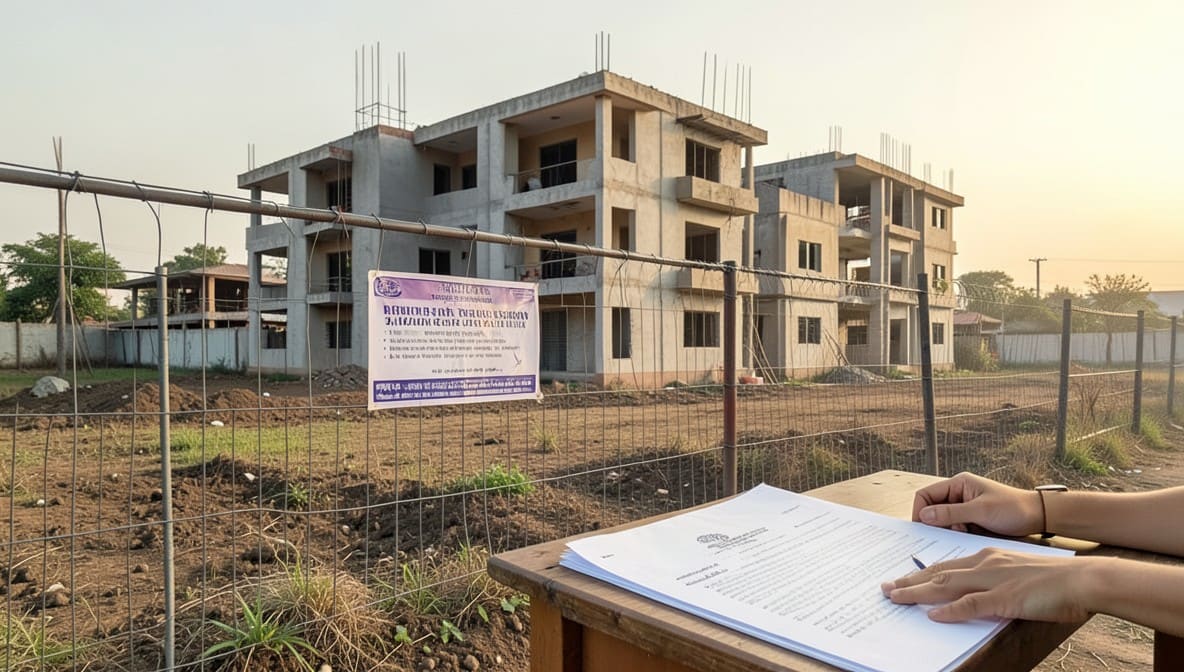
The dispute centers on a parcel of land in Village Morar, Pargana and District Gwalior, comprising Survey Nos. 1199/12, 1198, 1192, 1200, 1201, 1202, 1203, 1204, 1206/10, 1207, 1208, 1209, 1210/3, and 1211/min-3. The petitioner, Ashok Singh Gurjar, claims ownership and possession over the land and asserts that he constructed a building thereon with valid municipal permission. The respondent, Municipal Corporation, Gwalior, contends that the land is government land and that the petitioner’s construction is unauthorized.
Key Facts
- The petitioner filed a civil suit on 24-10-2024 seeking declaration of title and permanent injunction against interference with possession and construction.
- On 14-11-2024, the Trial Court granted an interim order restraining the respondent from interfering with possession or dismantling construction.
- On 24-12-2024, the Trial Court granted a temporary injunction under Order 39 Rules 1 and 2 of the CPC, reaffirming the earlier restraint.
- The Municipal Corporation filed a miscellaneous civil appeal under Order 43 Rule 1(r) of the CPC on 27-12-2024.
- The Appellate Court proceeded ex-parte against the petitioner on 20-02-2025, citing non-appearance.
- On 17-03-2025, the Appellate Court allowed the respondent’s application under Order 41 Rule 27 CPC to produce a Tehsildar’s report dated 21-10-2024, which claimed the land was government property.
- The Appellate Court, relying on this report, set aside the temporary injunction on 17-03-2025.
- The petitioner filed an application under Order 41 Rule 21 CPC on 22-03-2025 seeking rehearing and interim relief.
- On 29-04-2025, the Appellate Court dismissed the application under Order 41 Rule 21 CPC without granting a hearing on the additional evidence.
- The petitioner filed the present petition under Article 227 of the Constitution on 05-05-2025.
Procedural History
- 24-10-2024: Civil suit filed before Trial Court (Suit No. not specified)
- 14-11-2024: Trial Court granted interim restraint against interference
- 24-12-2024: Trial Court granted temporary injunction under Order 39 Rules 1 and 2 CPC
- 27-12-2024: Municipal Corporation filed Misc. Civil Appeal No. 07 of 2025
- 20-02-2025: Appellate Court proceeded ex-parte against petitioner
- 17-03-2025: Appellate Court allowed additional evidence under Order 41 Rule 27 CPC and set aside injunction
- 22-03-2025: Petitioner filed application under Order 41 Rule 21 CPC for rehearing
- 29-04-2025: Appellate Court dismissed Order 41 Rule 21 application without hearing
- 05-05-2025: Petitioner filed Writ Petition under Article 227 before High Court
Relief Sought
The petitioner sought setting aside of the orders dated 17-03-2025 and 29-04-2025, restoration of the temporary injunction, and directions to the Trial Court to expedite the suit.
The Legal Issue
The central question was whether an Appellate Court may set aside a temporary injunction granted by the Trial Court under Order 41 Rule 27 CPC by admitting additional evidence without affording the opposite party an opportunity to rebut it, and whether such a procedure violates the principles of natural justice.
Arguments Presented
For the Petitioner
The petitioner’s counsel contended that the Appellate Court violated natural justice by proceeding ex-parte and then admitting a critical document - the Tehsildar’s report - without giving the petitioner any opportunity to examine, cross-examine, or rebut it. It was argued that Order 41 Rule 27 CPC permits additional evidence only if the Appellate Court is satisfied that it could not have been produced earlier despite due diligence, and even then, the opposite party must be given a fair chance to respond. The petitioner also emphasized that the construction was carried out with municipal permission and that the balance of convenience favored preservation of status quo.
For the Respondent
The respondent’s counsel supported the Appellate Court’s decision, relying on the Tehsildar’s report dated 21-10-2024 to assert that the land was government property. It was submitted that the petitioner had no lawful title and that the construction was unauthorized. The respondent argued that the Trial Court’s injunction was granted prematurely and that the Appellate Court was justified in vacating it upon receipt of official revenue records.
The Court's Analysis
The Court observed that the determination of ownership over the disputed land is a complex question of fact and law, requiring examination of revenue records, municipal permissions, and title documents - all of which are best adjudicated at the trial stage. The Court emphasized that interim relief under Order 39 CPC is not a determination of title, but a measure to preserve the subject matter of the suit pendente lite.
"The preservation of the property pendente lite is essential to avoid irreparable injury. If the construction is dismantled at this stage and the petitioner eventually succeeds in the suit, the loss would be irreversible."
The Court further held that the Appellate Court’s admission of the Tehsildar’s report under Order 41 Rule 27 CPC without affording the petitioner an opportunity to respond was a procedural illegality. The rule permits additional evidence only if it is shown that the evidence could not have been produced earlier despite due diligence, and even then, the opposing party must be heard. The Appellate Court failed to satisfy either condition.
The Court also noted that the ex-parte proceedings against the petitioner were not justified, as there was no evidence of deliberate non-appearance or notice failure. The Court concluded that the Appellate Court’s actions undermined the foundational principle of audi alteram partem.
The Verdict
The petitioner succeeded. The Court set aside the orders dated 17-03-2025 and 29-04-2025. The respondent-Municipal Corporation is directed not to dismantle the construction raised by the petitioner, and is restrained from interfering with his possession over the suit property until the final disposal of the civil suit. The Trial Court is directed to expedite the suit and decide it on its merits without being influenced by any observations made in this order. No costs were awarded.
What This Means For Similar Cases
Fair Hearing Is Non-Negotiable in Interim Relief Matters
- Practitioners must insist on a hearing before any additional evidence is admitted under Order 41 Rule 27 CPC
- Ex-parte proceedings in injunction appeals are impermissible unless the court is satisfied that notice was properly served and the party deliberately absented
- Courts must record reasons for admitting additional evidence and ensure rebuttal opportunity
Preservation of Status Quo Trumps Preliminary Title Disputes
- Courts should not vacate injunctions based solely on preliminary revenue reports
- The burden to prove unauthorized construction lies with the party seeking to dismantle it
- Interim orders must prioritize preventing irreversible harm over premature adjudication of title
Appellate Courts Cannot Act as Trial Courts
- Appellate courts are not forums for initial fact-finding
- Admission of new evidence must be strictly limited to cases of genuine hardship and due diligence
- Any deviation from this principle renders the order liable to be set aside under Article 227