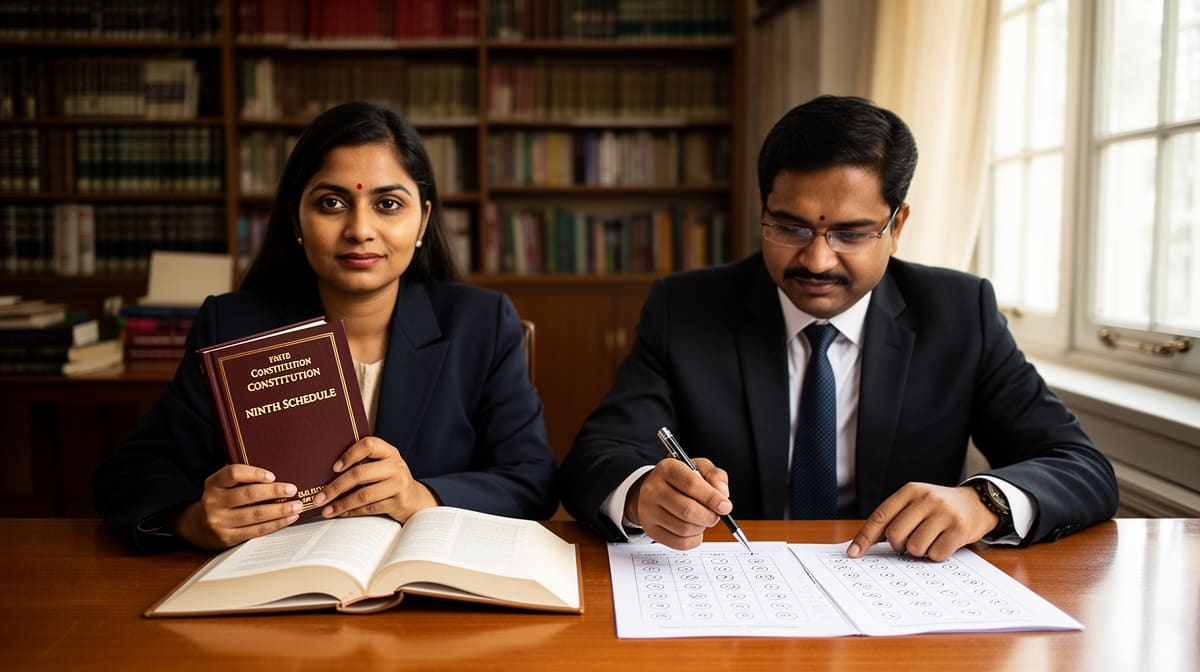
The Supreme Court has held that when a constitutional question in a competitive recruitment exam admits two plausible interpretations grounded in binding precedent, neither candidate may be unfairly disadvantaged. In a landmark ruling, the Court directed the creation of a supernumerary post to ensure fairness, affirming that constitutional literacy cannot be reduced to a single-answer multiple-choice test.
Background & Facts
The Dispute
The Municipal Corporation, Chandigarh, conducted a recruitment examination for the post of Law Officer, selecting candidates solely on the basis of a written test comprising 100 multiple-choice questions, each carrying one mark. A negative marking of 1/4th mark was applied for each incorrect answer. The appellant, Charan Preet Singh, and the third respondent, Amit Kumar Sharma, both appeared for the examination. The dispute arose over the correct answer to Question No. 73, which asked: "Which of the following schedule of the Constitution is immune from judicial review on the grounds of violation of fundamental rights?" The options were: A) Seventh Schedule, B) Ninth Schedule, C) Tenth Schedule, D) None of the above.
Key Facts
- The recruiting body (Municipal Corporation, Chandigarh) marked Option B (Ninth Schedule) as correct.
- The third respondent, Amit Kumar Sharma, selected Option D (None of the above), which was marked wrong.
- As a result, Sharma lost 1 mark for the incorrect answer and an additional 0.25 mark due to negative marking, totaling a deduction of 1.25 marks.
- This deduction altered the merit ranking, causing Sharma to be ranked below the appellant, who was selected and joined service.
- Sharma filed a writ petition (CWP No. 1007 of 2022) before the Punjab and Haryana High Court challenging the answer key.
- The Single Judge dismissed the petition on 07.02.2022, holding that the Ninth Schedule remains immune from judicial review on grounds of fundamental rights violation, citing Shankari Prasad, Sajjan Singh, and I.R. Coelho.
- The Division Bench, on 29.05.2025, allowed Sharma’s appeal, holding that Option D was legally correct because the Ninth Schedule is not absolutely immune - judicial review is available on the basis of the basic structure doctrine.
Procedural History
- 15.01.2022: Recruitment examination conducted by Municipal Corporation, Chandigarh.
- 20.01.2022: Provisional answer key published; Option B declared correct for Question No. 73.
- 25.01.2022: Amit Kumar Sharma filed representation challenging the answer key; rejected on 05.02.2022.
- 07.02.2022: Single Judge of Punjab and Haryana High Court dismissed CWP No. 1007 of 2022.
- 29.05.2025: Division Bench of Punjab and Haryana High Court allowed LPA No. 286 of 2022, setting aside the Single Judge’s order.
- 16.12.2025: Special Leave Petition (C) No. 16533 of 2025 filed by Charan Preet Singh in the Supreme Court.
- 17.03.2026: Supreme Court delivered judgment.
The Parties' Positions
-
Appellant (Charan Preet Singh): Argued that Option B (Ninth Schedule) is the correct answer based on the settled position that laws in the Ninth Schedule enjoy immunity from judicial review on grounds of fundamental rights violation, as affirmed in I.R. Coelho. He contended that the Division Bench erred in overruling the Single Judge’s interpretation and that his appointment, already consummated, cannot be undone.
-
Third Respondent (Amit Kumar Sharma): Contended that Option D (None of the above) is correct because the immunity of the Ninth Schedule is not absolute. He relied on I.R. Coelho, which held that laws in the Ninth Schedule are subject to judicial review if they violate the basic structure of the Constitution. He argued that a law graduate is expected to apply this nuanced doctrine, and his answer was legally sound.
Relief Sought
- The appellant sought to uphold his appointment and reject the third respondent’s claim.
- The third respondent sought revision of his score, inclusion in the merit list, and appointment to the post of Law Officer.
The Legal Issue
The central question was whether Option D (None of the above) is a legally correct answer to the question asking which schedule of the Constitution is immune from judicial review on grounds of violation of fundamental rights, given the evolving jurisprudence on the basic structure doctrine and the limitations on Article 31B as clarified in I.R. Coelho.
Arguments Presented
For the Appellant
The appellant’s counsel argued that the Ninth Schedule has been consistently held to be immune from judicial review on the ground of violation of fundamental rights, as affirmed in Shankari Prasad, Sajjan Singh, and I.R. Coelho. He contended that I.R. Coelho did not abolish this immunity but merely introduced a limited exception - the basic structure test. Therefore, the statement that the Ninth Schedule is immune from judicial review on grounds of fundamental rights remains substantially true, making Option B correct. He further argued that allowing Option D would create ambiguity in legal education and recruitment standards, and that the appellant’s appointment, already in effect, must be protected.
For the Respondent
The third respondent’s counsel relied on I.R. Coelho, particularly paragraph 148, which states that laws in the Ninth Schedule are not immune from judicial review if they destroy the basic structure of the Constitution. He argued that the question’s phrasing - "immune from judicial review on the grounds of violation of fundamental rights" - is misleading because the immunity is conditional. Since no schedule is absolutely immune, Option D is the only correct answer. He emphasized that as a law graduate, his answer reflected a correct understanding of constitutional jurisprudence, and the deduction of 1.25 marks unfairly deprived him of selection.
The Court's Analysis
The Court undertook a detailed review of the constitutional jurisprudence surrounding the Ninth Schedule, beginning with Shankari Prasad, which upheld Parliament’s power to amend fundamental rights, followed by Golak Nath, which held such amendments invalid, and then Kesavananda Bharati, which introduced the basic structure doctrine. The Court then examined I.R. Coelho, where it held that while Article 31B grants immunity, it does not confer absolute protection. The Court observed:
"The immunity granted to the Ninth Schedule laws qua violation of fundamental rights has not been done away with and it continues. But some effect of such violation has been brought within the purview of the judicial review so as to reclaim power to pronounce upon the validity of laws included in the Ninth Schedule."
The Court noted that the Single Judge interpreted this to mean the Ninth Schedule remains immune, while the Division Bench correctly held that the immunity is qualified. The Court agreed with the Division Bench that Option D is legally tenable. However, it emphasized that the question, as framed, required interpretation of complex constitutional precedents spanning over five decades. The Court observed:
"When the Judges of the High Court are at variance in their opinion as to the correct answer to Question No.73, it is least expected from mere law graduates, who are competing for a post of Law Officer in the Municipal Corporation, to reach to a correct conclusion while answering the multiple-choice question by process of interpretation of Constitutional provisions involving this Court’s judgments in several decades."
The Court concluded that both answers - Option B and Option D - are reasonably defensible under constitutional law. To uphold fairness and avoid penalizing either candidate for a question that even the High Court could not resolve unanimously, the Court invoked the principle of equity.
The Verdict
The Supreme Court allowed the appeal in part and directed the Municipal Corporation, Chandigarh, to create a supernumerary post for the Law Officer position and appoint both the appellant, Charan Preet Singh, and the third respondent, Amit Kumar Sharma. Upon appointment of the third respondent, the appellant shall be treated as senior in service. The Court emphasized that the constitutional right of a deserving candidate cannot be defeated by delay, and the creation of a supernumerary post is a just and equitable remedy under Vikas Pratap Singh v. State of Chhattisgarh.
What This Means For Similar Cases
Constitutional Questions in Recruitment Exams Must Be Unambiguous
- Practitioners must challenge recruitment exams where questions on constitutional law are framed in a manner that invites conflicting interpretations of binding precedents.
- Recruitment bodies must avoid questions requiring deep doctrinal analysis unless explicitly testing advanced constitutional knowledge.
- Where two answers are legally plausible, the principle of in dubio pro candidato (in doubt, for the candidate) should apply.
Supernumerary Posts Are a Valid Equitable Remedy
- Where a candidate is unfairly excluded due to an ambiguous answer key, courts may direct creation of a supernumerary post even after appointment has been made.
- This remedy preserves the integrity of merit-based selection without displacing an already-appointed candidate.
- The seniority of the original appointee is preserved, ensuring administrative stability.
Legal Education Standards Are Under Scrutiny
- Law graduates appearing for public sector exams are not expected to resolve conflicting constitutional interpretations without guidance.
- Recruitment authorities must ensure answer keys are vetted by constitutional experts before publication.
- Future question papers should avoid phrasing that conflates historical immunity with current legal limits.