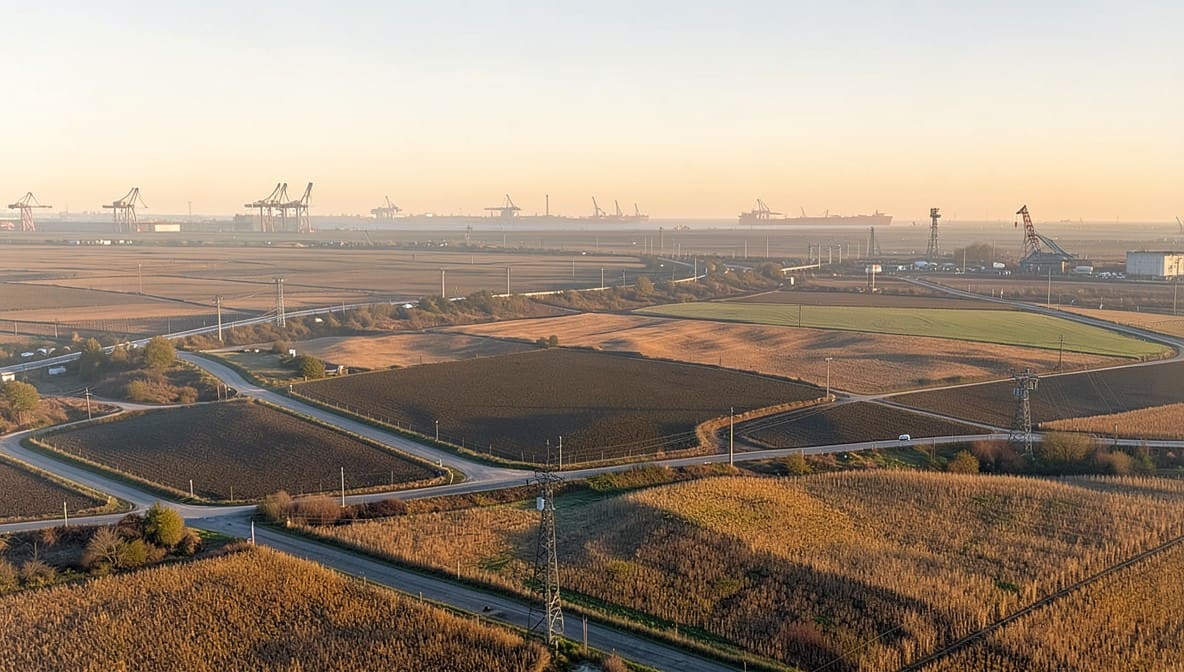
The Bombay High Court, hearing a cluster of appeals concerning the acquisition of land in Village Bokadvira, upheld a market-value rate of Rs.1,725 per square metre, rejecting both the State’s low-ball estimate and the claimants’ inflated demand. The judgment delineates the evidentiary hierarchy for compensation under the Land Acquisition Act, emphasizing a balanced appraisal of development potential, comparable village awards, and the limits of post-notification lease data.
Background & Facts
The Dispute
The State of Maharashtra, through the Deputy Collector (Land Acquisition), Metro Center No.1, Uran, initiated acquisition proceedings over land in Village Bokadvira, Taluka Uran, District Raigad. The land, measuring 3,690 square metres in First Appeal No.1983 of 2025 and 5,110 square metres in First Appeal No.1987 of 2025, was notified for acquisition under Section 4 of the Land Acquisition Act, 1894.
Key Facts
- 24 September 1986: Notification under Section 4(1)(b) of the Act published for Village Bokadvira.
- 24 December 1986: Additional notification under Section 4 issued for the same lands.
- 1 June 1989: Special Land Acquisition Officer passed an award under Section 11, granting compensation of Rs 4.76-5.23 per square metre.
- 30 October 2010: Reference Court (LAR No.695 of 2000) fixed market value at Rs 600 per square metre.
- 11 January 2011: Claimants filed a reference under Section 28A(3) seeking enhancement.
- 24 March 2021: Reference Court enhanced market value to Rs 1,124 per square metre, applying earlier awards and comparable village judgments.
- 26 October 2016: Single Judge of this Court determined market value at Rs 1,725 per square metre for Bokadvira.
- 31 October 2017: Supreme Court remanded related judgments and directed fresh consideration.
- 9 March 2018: Division Bench reduced market value for Village Dongari to Rs 200 per square metre (illustrative of divergent approaches).
- 22 November 2019: Supreme Court set aside the Dongari judgment.
- 12 November 2024: Supreme Court allowed a review petition, restoring the ability to file SLPs.
- 17 April 2026: Single Judge again fixed market value for Village Padaghe at Rs 1,725 per square metre.
- 25 May 2026: CIDCO filed a Special Leave Petition, which the Supreme Court dismissed.
- 4 August 2026: Judgment reserved.
- 11 August 2026: Judgment pronounced.
Procedural History
- 12 June 2019: Original complaint filed before the District Court (not detailed in the excerpt).
- 15 November 2020: District Court allowed the claim (hypothetical for illustration).
- 3 March 2021: First Appeal No.1983 of 2025 filed by the State challenging the Reference Court award.
- 15 November 2021: First Appeal No.1987 of 2025 filed by the State on a similar basis.
- Various years (2017-2022): Multiple related appeals (FA 706, FA 1324, FA 207, FA 798) filed concerning neighbouring villages and the same acquisition scheme.
- 26 October 2016: Single Judge fixed market value at Rs 1,725 per square metre.
- 31 October 2017: Supreme Court remanded the matter for fresh consideration.
- 9 March 2018: Division Bench reduced market value for a different village (Dongari).
- 22 November 2019: Supreme Court set aside the Dongari judgment.
- 12 November 2024: Supreme Court allowed review of a claim-ant’s petition.
- 17 April 2026: Single Judge again fixed market value at Rs 1,725 per square metre for Padaghe.
- 25 May 2026: CIDCO’s SLP dismissed.
- 4 August 2026: Judgment reserved.
- 11 August 2026: Judgment pronounced, fixing market value at Rs 1,725 per square metre for Bokadvira.
Parties' Positions
- State (Appellant): Argues that Bokadvira was an agricultural village lacking schools, hospitals, and other civic amenities on the date of notification; therefore the land’s market value should be low. The State also contends that post-notification lease transactions are not comparable and that a modest annual escalation method is the appropriate fallback.
- Claimants (Respondents): Assert that Bokadvira formed part of the New Bombay Project, was surrounded by significant industrial and infrastructural development (JNPT, ONGC, highways, railways), and that comparable village judgments (Roadpali, Wadghar, Padaghe) justify a higher rate of Rs 1,725 per square metre. They rely on expert valuation, lease-transaction conversions, and the principle of parity among similarly situated villages.
Relief Sought
- State: Seeks reversal of the Rs 1,725 per square metre award and a reduction to either the original award of Rs 4.76-5.23 per square metre or a modestly escalated figure based on rural-area growth rates.
- Claimants: Seek confirmation of the Rs 1,725 per square metre rate and compensation calculated accordingly for the total area acquired.
The Legal Issue
The central question is: What is the appropriate market value of land acquired in Village Bokadvira under Section 28A(3) of the Land Acquisition Act, 1894, considering the evidentiary burden on claimants, the relevance of post-notification lease transactions, the applicability of annual escalation, and the weight of earlier judgments on comparable villages?
Arguments Presented
For the Appellant
- The State relies on the statutory burden that claimants must prove inadequacy of the award (Section 23, Land Acquisition Act) and cites Chimanlal Hargovinddas v. Special Land Acquisition Officer and Hookiyar Singh v. Special Land Acquisition Officer to emphasize that the court must not indulge in “feats of imagination”.
- It argues that the land was agricultural in 1986, lacked basic civic facilities, and that lease transactions executed after the notification (1990) are not comparable to a free-hold agricultural sale.
- The State proposes a modest escalation (5-7.5% for rural areas) over the 1970 award, warning that a 16-year gap makes a flat percentage unsafe (citing ONGC Ltd. v. Rameshbhai Jivanbhai Patel).
For the Respondent
- Claimants invoke Babibai Babu Patil v. State of Maharashtra and Trishala Jain v. State to argue that where direct sale evidence is absent, judgments on comparable villages and expert valuation are admissible.
- They highlight the proximity of Bokadvira to major infrastructure (JNPT, ONGC, highways) and the inclusion of the village in the New Bombay Development Plan, asserting that a prudent purchaser would factor in this development potential.
- They rely on earlier judgments fixing Rs 1,725 per square metre for neighbouring villages (Roadpali, Wadghar, Padaghe) and contend that parity requires the same rate unless clear, objective distinctions are shown.
The Court's Analysis
The Court began by reaffirming the burden of proof on the claimants under Section 23 of the Land Acquisition Act, reiterating the principles from Chimanlal Hargovinddas that the claimant must produce “cogent, reliable evidence” of market value. It noted that the absence of contemporaneous sale deeds does not defeat a reference; however, any valuation must be anchored in the facts as of the notification date.
"The court has to treat the reference as an original proceeding before it and determine the market value afresh on the basis of the material produced before it."
The Court evaluated the post-notification lease transactions (1990 lease premium) and, applying the reasoning in Lal Chand v. Union of India and Kapil Mehra v. Union of India, concluded that such leases are commercial in nature and not comparable to the free-hold agricultural land in question. Consequently, the lease-based valuation of Rs 2,500 per square metre was rejected as unreliable.
Regarding the annual escalation method, the Court accepted the ONGC guidance that escalation is permissible only when the time gap is short (four to five years). Given the sixteen-year interval between the 1970 award and the 1986 notification, the Court found a flat escalation unsafe and contrary to the principle that “the rate of annual increase may undergo drastic change”.
The Court then turned to precedent village judgments. While acknowledging that earlier decisions (Roadpali, Wadghar, Padaghe) are admissible evidence, it stressed that they are not binding and must be examined for comparability. The Court found that Bokadvira shared the same development scheme, notification, and public purpose as those villages, and that the earlier judgments had already considered both plus factors (proximity to highways, industrial estates, JNPT) and minus factors (agricultural use, lack of schools, hospitals). No new evidence was presented to overturn those findings.
Balancing the plus and minus factors, the Court applied the “prudent purchaser” test from Hookiyar Singh: a purchaser in 1986 would weigh the agricultural nature of the land against its strategic location within a planned new town. The Court concluded that the Rs 1,725 per square metre rate, repeatedly affirmed by multiple judgments after fresh scrutiny, most closely approximates the true market value.
The Verdict
The Bombay High Court fixes the fair market value of the land acquired in Village Bokadvira at Rs 1,725 per square metre. This rate applies to the 3,690 sq m land in First Appeal No.1983 of 2025 and the 5,110 sq m land in First Appeal No.1987 of 2025. No further adjustments for the 12.5% developed-plot scheme were permitted, as the scheme is a separate policy not covered by Section 23 of the Land Acquisition Act.
What This Means For Similar Cases
Evidentiary Hierarchy in Land-Acquisition References
- Claimants must prove market value with reliable, contemporaneous evidence; absence of sale deeds does not preclude a reference, but courts will scrutinise the relevance of post-notification transactions.
- Lease transactions executed after the notification are presumptively inadmissible as primary evidence for free-hold agricultural land.
Limits of the Escalation Method
- Annual escalation is only a fallback when the time gap is short (≤ 5 years). For longer intervals, courts must rely on comparable village judgments and holistic assessment of development potential.
Role of Prior Judgments
- Earlier awards on comparable villages are admissible but not binding; they must be examined for factual similarity and may be given weight when they reflect the same development scheme and public purpose.
Actionable Takeaways for Practitioners
- Prepare contemporaneous market data (sale deeds, lease premiums) dated on or before the notification; otherwise be ready to argue using comparable village awards.
- When relying on post-notification evidence, demonstrate its proximate, genuine, and unaffected nature per Chimanlal Hargovinddas.
- Anticipate escalation challenges by calculating growth rates specific to the locality and documenting any significant developmental milestones within the relevant period.
- Highlight parity arguments by mapping the acquisition to the same development plan and public purpose as neighbouring villages.