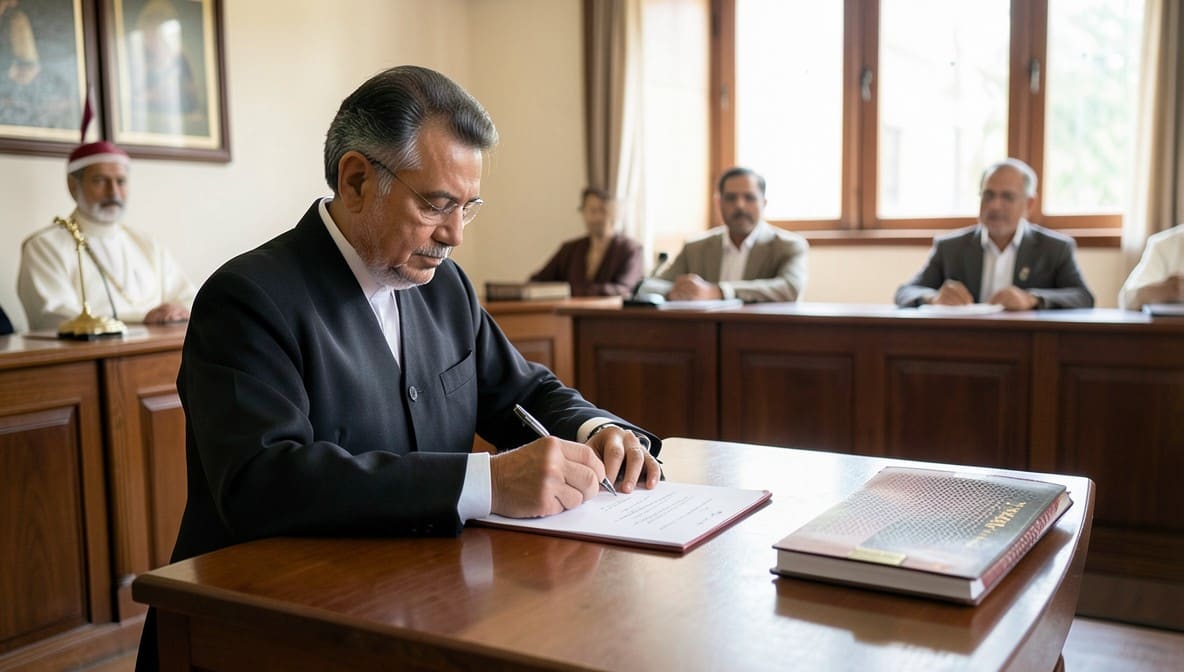
The Patna High Court has granted bail to a middle school teacher accused of submitting forged educational certificates, underscoring that prolonged service, clean antecedents, and absence of flight risk outweigh allegations of document fabrication in bail jurisprudence. The order provides critical guidance on the application of bail principles in service-related fraud cases under the IPC.
Background & Facts
The Dispute
The petitioner, Pawan Kumar Mandal @ Pawan Mandal, is a middle school Mauahi (teacher) in Madhubani district, Bihar. He is accused in Babubarhi Police Station Case No. 18 of 2026, registered on 08.01.2026, under Sections 420 (cheating), 467 (forgery of valuable security), 468 (forgery for purpose of cheating), 471 (using forged document as genuine), and 120B (criminal conspiracy) of the Indian Penal Code. The allegation is that he obtained his teaching position by submitting forged academic certificates.
Key Facts
- The petitioner has been in judicial custody since 14.02.2026.
- He has served as a teacher for approximately 15 years, continuously employed since joining the service.
- The State’s case hinges on a mismatch between the certificate submitted by the petitioner and the records of the issuing institution.
- The petitioner claims that after his appointment, the concerned educational authority verified his certificate with the university and confirmed its authenticity.
- The petitioner has successfully passed the Elementary Teacher Evaluation Examination conducted by the State of Bihar.
- The FIR was registered pursuant to a Public Interest Litigation (CWJC No. 15459/2014) filed against alleged fraudulent appointments in government schools across Bihar.
- No prior criminal record or disciplinary action against the petitioner exists.
Procedural History
- 08.01.2026: FIR registered at Babubarhi Police Station, Madhubani.
- 14.02.2026: Petitioner arrested and placed in custody.
- 29.04.2026: Criminal Miscellaneous Application No. 28757 of 2026 filed before the Patna High Court seeking bail.
The Parties' Positions
For the Petitioner:
- The allegations are fabricated and politically motivated, arising from a state-wide probe initiated under a PIL.
- The certificate was verified and accepted by the authorities at the time of appointment.
- The petitioner has no criminal antecedents and has served diligently for 15 years.
- His continued detention is unjustified given his long-standing public service and lack of flight risk.
For the Respondent (State and Vigilance):
- The petitioner has not resigned from his post, unlike other accused persons who approached the Court after leaving service.
- The nature of the offence involves forgery of official documents, which undermines public trust in the education system.
- Granting bail may set a precedent that weakens the state’s ability to prosecute systemic fraud.
Relief Sought
The petitioner seeks immediate release on bail with reasonable conditions, pending trial in Babubarhi P.S. Case No. 18 of 2026.
The Legal Issue
The central question was whether bail can be granted to a public servant accused of forgery under Sections 467, 468, and 471 IPC, where the accused has a clean record, has served for over a decade, and the alleged forgery was verified and accepted by the appointing authority at the time of recruitment.
Arguments Presented
For the Appellant/Petitioner
Mr. Vindhyachal Singh, Senior Advocate, argued that the petitioner’s 15-year unblemished service establishes his credibility and negates any presumption of guilt. He cited Arnesh Kumar v. State of Bihar to emphasize that arrest and custody must be the exception, not the rule, especially where the offence is non-violent and the accused has no history of criminal conduct. He further submitted that the verification of documents by the university post-appointment negates the element of dishonest intent at the time of submission. The petitioner’s participation in the state’s teacher evaluation exam further demonstrates his commitment to lawful service.
For the Respondent/State
Mr. Anand Kishore Choudhary, Additional Public Prosecutor, contended that forgery of educational certificates in government service is a serious offence affecting public integrity. He distinguished Arnesh Kumar by noting that this case involves institutional fraud, not a private dispute. He argued that the petitioner’s continued employment, unlike other accused who resigned, indicates an attempt to evade accountability. The Vigilance counsel, Mr. Arvind Kumar, added that the FIR was part of a broader state initiative to cleanse the teaching cadre, and granting bail could undermine deterrence.
The Court's Analysis
The Court examined the nature of the allegations, the petitioner’s conduct over 15 years, and the absence of any prior misconduct. It noted that the State had already verified the petitioner’s certificate with the university after his appointment, which directly contradicts the claim of fraudulent intent at the time of application. The Court observed that the mere existence of a discrepancy between records does not, by itself, establish criminality, particularly where the document was accepted by the appointing authority.
"The petitioner has been in service for fifteen years without any adverse report. The certificate was verified by the institution after appointment. This negates the allegation of dishonest intent at the time of submission."
The Court further held that the petitioner’s arrest was disproportionate given his clean antecedents, lack of flight risk, and the non-violent nature of the offence. It rejected the State’s argument that the petitioner’s failure to resign distinguished him from others, noting that resignation is not a precondition for bail. The Court emphasized that bail is the rule and jail the exception, particularly under Section 439 CrPC, and that the gravity of the offence must be balanced against the accused’s personal circumstances.
The Court also rejected the notion that systemic investigations justify automatic denial of bail. It held that each case must be decided on its own merits, and the petitioner’s long tenure and service record constitute compelling reasons for release.
The Verdict
The petitioner succeeded. The Patna High Court granted bail on furnishing a personal bond of Rs. 10,000 with two sureties of Rs. 10,000 each, to be approved by the Chief Judicial Magistrate, Madhubani. The petitioner must appear in court on all dates, remain physically present, and not tamper with evidence or witnesses. Bail may be cancelled if the petitioner is absent for two consecutive dates without cause, or if his criminal antecedents are found to have been concealed. The court directed that verification of antecedents must not delay bail acceptance.
What This Means For Similar Cases
Clean Service Record Overrides Alleged Forgery
- Practitioners representing accused public servants must highlight uninterrupted service, prior verification of documents by authorities, and absence of disciplinary action.
- A certificate verified post-appointment weakens the prosecution’s claim of dishonest intent under Section 467-471 IPC.
Bail Is Not Denied Solely on Systemic Investigations
- FIRs arising from state-wide PIL-driven probes do not justify automatic denial of bail.
- Each accused must be evaluated individually; collective punishment through custody is impermissible under Article 21.
Verification Delays Cannot Be Used to Justify Prolonged Custody
- Courts must ensure that procedural verification of antecedents does not become a tool to prolong detention.
- The order mandates that bail acceptance cannot be delayed pending verification - a critical procedural safeguard.
No Resignation Required for Bail Eligibility
- The failure to resign from service cannot be used as a ground to deny bail.
- This removes a potential procedural trap used by prosecution to justify custody in service-related fraud cases.
Burden of Proof on Dishonest Intent
- The prosecution must prove dishonest intent at the time of submission, not merely a discrepancy in records.
- Post-appointment verification by the employer shifts the evidentiary burden and may negate criminal liability.