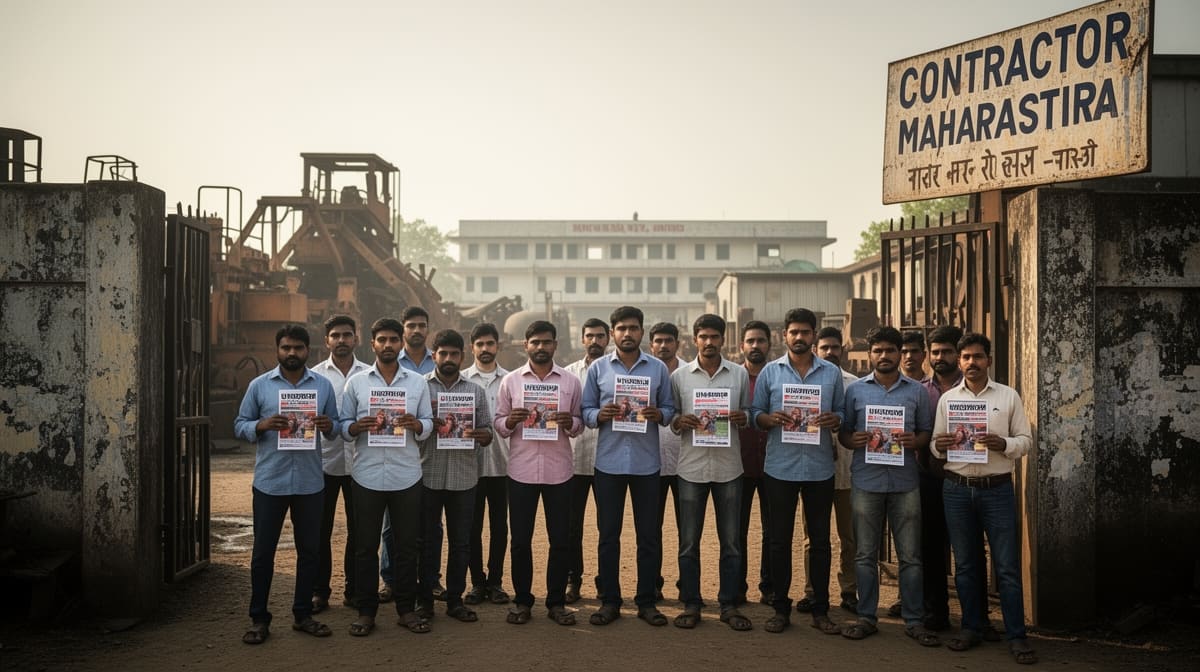
The Calcutta High Court examined whether a contractual jurisdiction clause could oust the statutory reach of a West Bengal industrial tribunal and whether a domestic enquiry fraught with procedural irregularities warranted setting aside an award that ordered reinstatement with full back wages.
Background & Facts
The Dispute
The petitioner, ICPA Health Products Limited, challenged an award of the 7th Industrial Tribunal, West Bengal dated 31 March 2016 (Case No.16/1008(d) of 2012). The award reinstated the private respondent (employee) and ordered payment of back wages. The petitioner contended that the tribunal lacked territorial jurisdiction and that the domestic enquiry leading to dismissal was illegal.
Key Facts
- 02 February 1990: Private respondent appointed as Medical Representative; appointment letter issued 08 February 1990.
- 01 June 1991: Service confirmed by the company.
- 2009: Dispute arose concerning alleged irregularities.
- 29 March 2010: Company issued a letter calling the employee to a preliminary enquiry on 09 April 2010.
- 13 April 2010: Suspension order issued.
- 16 April 2010: Formal charge-sheet with eight charges served.
- 24/28 April 2010: Employee submitted explanations; letter of objection dated 26 April 2010.
- 19 May 2010: Notice fixing domestic enquiry for 02 June 2010; Enquiry Officer appointed Mr. Dwarkanath N. Waykul.
- 27 May 2010: Employee requested the enquiry be held in West Bengal and sought legal representation.
- 02 June 2010: Domestic enquiry commenced at the company’s Mumbai head office; request to shift venue rejected.
- 10 June 2010: Employee again sought representation and venue change.
- 15 July 2010: Employee appeared, requested travel expenses.
- 16 August 2010: Employee unable to attend due to a two-day strike.
- 19 August 2010: Enquiry proceeded ex-parte; employee absent.
- 06 September 2010: Presenting Officer changed to Mr. Ramesh J. Virdikar.
- 08 September 2010: Employee appeared with defence counsel, objected to procedural aspects.
- 24 September 2010: Written objection filed regarding new Presenting Officer and other issues.
- 09 November 2010: Defence counsel cross-examined management witness; cross-examination completed 02-03 December 2010.
- 29 December 2010: Domestic enquiry concluded; report dated 12 January 2011 found employee guilty.
- 04 March 2011: Second show-cause notice issued.
- 23 March 2011: Employee sought extension to 05 April 2011; request ignored.
- 24 March 2011: Dismissal order passed; protest letters dated 26 and 29 March 2011.
- 21 April 2011: Employee raised industrial dispute before the West Bengal Labour Commissioner.
- 10 August 2011: Management submitted response objecting to territorial jurisdiction.
- 01 September 2011: Employee filed counter-reply asserting West Bengal nexus.
- 11 November 2011: Conciliation Officer issued Form-S certificate; employee invoked jurisdiction of the 7th Industrial Tribunal.
- 2012: Case No. 16/1008(d) filed before the 7th Industrial Tribunal.
- 31 December 2014: Tribunal passed award reinstating employee with back wages.
- 15 October 2015: Single Judge of this Court remanded the dispute to the Tribunal for jurisdictional determination.
- 24 February 2016: Appeal Bench directed the Tribunal to pass an award by 31 March 2016.
- 31 March 2016: Impugned award dated.
- 02 September 2026: Judgment of the present writ petition delivered.
Procedural History
- 02 September 2026: Writ petition (WPO 737 of 2016) filed before the Calcutta High Court challenging the award.
- 15 October 2015: Single Judge order remanding the dispute to the Tribunal.
- 24 February 2016: Appeal Bench order directing award by 31 March 2016.
- 31 March 2016: Award passed by the 7th Industrial Tribunal.
- 02 September 2026: Present judgment.
Parties' Positions
- Petitioner (ICPA Health Products Ltd.): Asserted that the appointment letter’s jurisdiction clause (Mumbai) and Notification No. 101-IR/12L-14/1 dated 02 February 2012 excluded West Bengal tribunals; claimed the domestic enquiry was procedurally defective; argued that reinstatement with full back wages was disproportionate.
- Respondent No. 2 (Employee): Maintained that the dispute arose in West Bengal, the situs of employment, giving the state tribunals jurisdiction; contended that the domestic enquiry denied a fair opportunity and that he remained unemployed, thus entitled to back wages under Section 11 and Section 17B of the Industrial Disputes Act, 1947.
Relief Sought
- Petitioner: Set aside the award, declare the 7th Industrial Tribunal lacked jurisdiction, and vacate the reinstatement and back-wage order.
- Respondent No. 2: Uphold the award, confirm reinstatement and full back wages, and seek consequential retirement benefits.
The Legal Issue
The central questions were: (1) Whether the contractual jurisdiction clause in the employee’s appointment letter and the 2012 notification could deprive the 7th Industrial Tribunal of territorial jurisdiction to adjudicate the dispute; (2) Whether the domestic enquiry was so flawed as to render the dismissal illegal; and (3) Whether reinstatement with full back wages was an appropriate remedy.
Arguments Presented
For the Petitioner
- Relied on the appointment-letter clause designating Mumbai as the exclusive forum and on Notification No. 101-IR/12L-14/1 (02 Feb 2012) limiting the 7th Tribunal’s territorial reach.
- Cited Swastik Gases Private Ltd. v. Indian Oil Corp. Ltd. and Rakesh Kumar Verma v. HDFC Bank Ltd. to argue that an exclusive jurisdiction clause is enforceable only if the designated forum is statutorily competent.
- Asserted that the domestic enquiry denied the employee a genuine opportunity to defend himself, violating natural justice.
- Contended that reinstatement with full back wages was disproportionate given the loss of confidence and the five-year lapse since dismissal.
For the Respondent
- Submitted that the situs of employment (West Bengal) and the cause of action (termination) anchored the dispute in the state, giving the 7th Tribunal jurisdiction irrespective of the contractual clause.
- Relied on Karnataka State Road Transport Corp. v. Lakshmidevamma, Divyash Pandit v. Management, and Kurukshetra University v. Prithvi Singh to emphasize procedural fairness in domestic enquiries.
- Cited Novartis India Ltd. v. State of West Bengal, Jagbir Singh v. Haryana State Agriculture Marketing Board, and PVK Distillery Ltd. v. Mahendra Ram to argue that back wages are not automatic but are warranted where the employee proves unemployment.
- Emphasised that the employee remained unemployed, satisfying the burden under Section 17B.
The Court's Analysis
The Court first examined the nature of a contractual jurisdiction clause. It observed that an industrial tribunal is a creature of statute; its jurisdiction flows from the Industrial Disputes Act, 1947 and the relevant government notification. While parties may agree on a forum where multiple competent courts exist, such agreement cannot create jurisdiction where the statute does not confer it.
"The principle, however, contains its own limitation of fundamental importance: the forum selected by agreement must possess jurisdiction in the first place. Contract cannot create jurisdiction where the law does not confer it."
Applying this, the Court held that the appointment-letter clause designating Mumbai could not oust the statutory jurisdiction of the West Bengal tribunal because the dispute arose from employment and termination that were substantially connected with West Bengal. The 2012 notification, although delineating territorial limits, did not negate the nexus between the employee’s service and the state. Consequently, the 7th Industrial Tribunal possessed territorial jurisdiction.
On the domestic enquiry, the Court noted numerous procedural deficiencies: denial of venue change, refusal to allow legal representation, failure to provide material on which charges were based, and the ex-parte conduct on 19 August 2010. Citing Karnataka State Road Transport Corp. and Divyash Pandit, the Court affirmed that natural-justice principles require a real and effective opportunity to defend oneself. The Tribunal’s finding of illegality was therefore upheld.
Regarding back wages, the Court accepted that reinstatement with full back wages is not automatic but is discretionary. It found that the employee had established unemployment, and the Tribunal had duly considered the loss of confidence and the passage of time before granting back wages. The Court concluded that the award’s quantum was within the permissible range of judicial discretion and not perverse.
Finally, the Court addressed the practical impossibility of physical reinstatement because the employee attained superannuation on 15 April 2021. It modified the relief to treat the employee as having remained in service until that date, granting consequential monetary and retirement benefits, subject to adjustment of any amounts already paid under the award or Section 17B.
The Verdict
The writ petition was dismissed. The Court upheld the award dated 31 March 2016, confirming the 7th Industrial Tribunal’s jurisdiction, the illegality of the domestic enquiry, and the propriety of reinstatement with back wages. The relief was modified to treat the employee as having continued in service up to 15 April 2021, granting appropriate monetary and retiral benefits and adjusting any prior payments.
What This Means For Similar Cases
Contractual Jurisdiction Clauses Are Not Paramount
- Parties cannot use an exclusive-jurisdiction clause to override statutory jurisdiction of an industrial tribunal.
- The tribunal’s jurisdiction must first exist under the Industrial Disputes Act before a contract can select a forum.
Domestic Enquiry Must Satisfy Real Fairness
- Procedural fairness requires a genuine opportunity to be heard, including venue considerations and legal representation.
- Ex-parte proceedings and denial of material evidence can render an enquiry illegal, inviting judicial intervention.
Back-Wage Awards Remain Discretionary
- Courts will not automatically award full back wages; they assess unemployment, loss of confidence, and the time elapsed.
- Employers must be prepared to produce evidence of gainful employment during the intervening period.
Practical takeaways for practitioners:
- Verify statutory jurisdiction before relying on contractual clauses.
- Ensure domestic enquiries comply with natural-justice standards; document all procedural steps.
- When seeking reinstatement, be ready to justify the quantum of back wages with employment-status evidence.