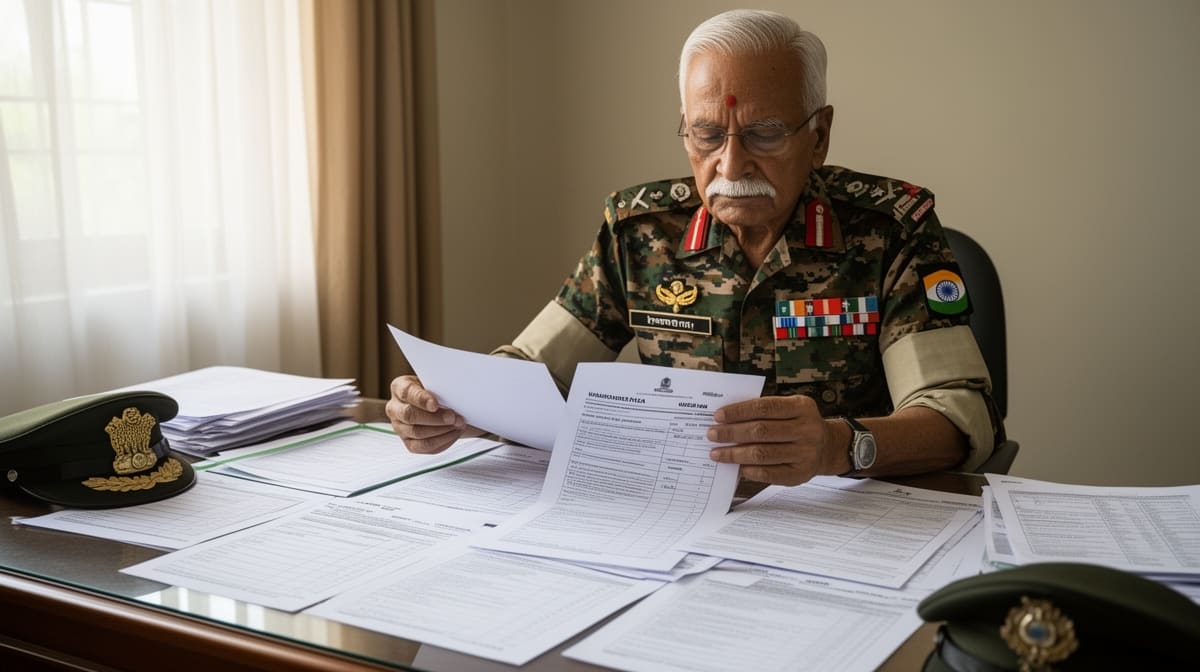
The Punjab and Haryana High Court has clarified that an employee who knowingly continues to draw higher pay after a confirmed reduction in rank cannot invoke equitable principles to block recovery of excess amounts. This judgment reinforces that administrative delays do not create vested rights when the employee is aware of the legal basis for lower entitlement.
Background & Facts
The Dispute
The petitioner, Kuldip Singh Rana, served in the Indian Army and was promoted to Havaldar in 1990. In 1996, a District Court Martial convicted him of embezzlement and imposed punishment of reduction in rank along with three months’ rigorous imprisonment. Although the punishment was confirmed in September 1996, administrative delays prevented formal implementation of the reduction in service records until 1998. During this period, the petitioner continued to draw pay and allowances at the Havaldar level.
Procedural History
- 1996: District Court Martial convicts petitioner and reduces rank
- 1996: Pre-confirmation petition rejected for procedural defect
- 1998: Punishment formally recorded via Part-II order
- 2000: Petitioner retires; pension calculated at TS-Naik level
- 2000: ₹66,988 recovered from salary arrears and pensionary benefits
- 2000: Writ petition filed under Articles 226/227 challenging recovery and pension fixation
Relief Sought
The petitioner sought quashing of the recovery of ₹66,988 and a writ of mandamus directing the respondents to fix his pension based on his last drawn pay as Havaldar, invoking Para 28 of the Pension Regulations for the Army, 1961.
The Legal Issue
The central question was whether recovery of excess salary paid due to administrative delay is legally permissible when the employee was aware, or ought reasonably to have been aware, that such payment was inconsistent with his lawful rank, and whether such circumstances fall outside the equitable bar ordinarily applicable against recovery of excess payments.
Arguments Presented
For the Petitioner
Learned counsel argued that the recovery was arbitrary and violative of natural justice, as no specific order was passed authorizing deduction. It was contended that the petitioner had no role in the delay and continued to receive pay in good faith, relying on the employer’s payment system. The pension, it was urged, must be calculated on the last pay drawn, regardless of its legality, as per Para 28 of the Pension Regulations.
For the Respondent
The State contended that the reduction in rank was a judicial punishment with immediate legal effect. The continued payment of higher emoluments was an administrative anomaly, not a vested right. Recovery was not punitive but corrective, aimed at restoring the legal position. The petitioner, as a disciplined soldier, could not reasonably claim ignorance of his reduced status.
The Court's Analysis
The Court traced the evolution of judicial doctrine on recovery of excess payments to government employees, distinguishing between innocent recipients and those who knowingly retain benefits. It relied on Chandi Prasad Uniyal v. State of Uttarakhand to affirm that public money paid without legal authority is recoverable. However, it acknowledged the equitable protection established in Syed Abdul Qadir v. State of Bihar and State of Punjab v. Rafiq Masih, which bars recovery where the employee is blameless and unaware.
"The equitable protection developed in service jurisprudence cannot extend to such circumstances."
The Court emphasized that the petitioner’s awareness of his conviction and punishment rendered any claim of innocence untenable. As a soldier subject to military discipline, he was presumed to understand that reduction in rank carried immediate consequences on pay and entitlement. His posting as a gunner after conviction further corroborated his awareness. The Court rejected the argument that pension must be computed on the last pay drawn, holding that "last pay drawn" refers only to lawful emoluments. To permit pension based on irregular payments would convert administrative error into a permanent liability on the exchequer.
The Court concluded that the recovery was not arbitrary but corrective, aligning the accounts with the petitioner’s true legal status. The doctrine of unjust enrichment and the maxim nullus commodum capere potest de injuria sua propria were invoked to deny relief where the employee derived advantage from his own knowledge of irregularity.
The Verdict
The petition was dismissed. The Court held that recovery of excess salary is lawful when the employee knew or ought reasonably to have known of the discrepancy in rank and pay, and that pension must be calculated on lawful emoluments, not on irregularly paid amounts.
What This Means For Similar Cases
Knowledge of Disciplinary Action Nullifies Equitable Protection
- Practitioners must now assess whether the employee had actual or constructive knowledge of the disciplinary action affecting pay
- Mere administrative delay does not create a right to retain excess payments if the employee was aware of the underlying punishment
- Military personnel and disciplined services are held to a higher standard of awareness regarding service status changes
Pension Calculation Must Reflect Lawful Rank, Not Administrative Anomalies
- Pension cannot be based on pay drawn during periods of unauthorized entitlement
- "Last pay drawn" under pension regulations refers only to legally sanctioned emoluments
- Employers may correct past errors without violating natural justice if the correction is retrospective to the date of legal disentitlement
Procedural Non-Compliance Does Not Validate Illegal Benefits
- Failure to issue formal orders does not validate continued receipt of higher pay
- Recovery can proceed even without a specific recovery order if the underlying entitlement is unlawful
- Petitioners cannot rely on procedural lapses by the employer to claim vested rights in excess payments