The Income Tax Appellate Tribunal "C" Bench, Kolkata allowed the assessee’s claim for depreciation on goodwill, brands and distribution network arising from a demerger where such assets were not recorded in the demerged company’s books, and set aside the disallowance under section 14A of the Act for failure to record dissatisfaction with the assessee’s apportionment. The Tribunal also directed the Assessing Officer to consider the assessee’s claim for deduction under section 80G.
Background & Facts
The Dispute
The assessee, Tata Consumer Products Limited, acquired the consumer products business of Tata Chemicals Ltd. pursuant to a demerger scheme sanctioned by the NCLT on 08.01.2020, with effect from 01.04.2019. The Assessing Officer disallowed depreciation of Rs.890.60 crore on goodwill and Rs.614.76 crore on brands and distribution network, and also disallowed Rs.8,82,00,000 under section 14A read with rule 8D of the Income Tax Rules, 1962, relating to expenditure incurred to earn exempt dividend income.
Key Facts
- The demerger scheme provided for issue of 114 fully paid equity shares of the assessee for every 100 shares of Tata Chemicals Ltd., determined by two Chartered Accountant firms and certified fair by M/s DSP Merrill Lynch Ltd.
- Merchant Bankers appointed by the assessee valued the brands and distribution network at Rs.2,459.01 crore and residual goodwill at Rs.3,562.41 crore (para 12).
- The assessee had earlier claimed a suo moto disallowance of Rs.62,16,000 under section 14A; the AO proposed additional disallowance of Rs.8,82,00,000 after deducting the suo moto amount (para 3).
- The assessee submitted explanations for its apportionment vide letters dated 16.01.2023 and 27.09.2023 before the AO (para 3).
- The Ld. DRP, after hearing the assessee’s objections, directed the AO to compute disallowance under section 14A as per rule 8D, asserting that the 2016 amendment removed the AO’s discretion (para 4).
- The final assessment order dated 27.06.2024 disallowed Rs.8,82,00,000 under section 14A as proposed in the draft order (para 4).
- Earlier, in ITA No.1869/Kol/2014 (A.Y. 2009-10), the Ld. coordinate bench had allowed the assessee’s apportionment and deleted the disallowance; the jurisdictional High Court dismissed the department’s appeal on 25.02.2019 (para 7).
- The assessee claimed depreciation on goodwill (Rs.890.60 crore), brands and distribution network (Rs.614.76 crore) and sought deduction under section 80G for donations of Rs.14,25,37,911 (para 9, 33).
- The Finance Act, 2021 amended the law to discontinue depreciation on goodwill with effect from AY 2021-22 (para 13, 23).
Procedural History
- 08.01.2020: NCLT sanctions the demerger scheme.
- 01.04.2019: Vesting of consumer products business in the assessee.
- 16.01.2023 & 27.09.2023: Assessee’s submissions to AO regarding section 14A apportionment.
- 19.06.2024: Ld. DRP’s direction to AO to apply rule 8D.
- 27.06.2024: Assessment order passed under section 143(3) read with section 144C(13).
- 14.07.2026: Date of hearing before ITAT.
- 07.10.2026: Date of pronouncement of the instant order.
- 13.12.2017: Order of Ld. coordinate bench in ITA No.1869/Kol/2014 (A.Y. 2009-10) deleting disallowance.
- 25.02.2019: High Court order dismissing department’s appeal in the aforesaid case.
Relief Sought
The assessee sought: (i) deletion of the Rs.8,82,00,000 disallowance under section 14A; (ii) allowance of depreciation of Rs.890.60 crore on goodwill and Rs.614.76 crore on brands/distribution network; (iii) consideration of its section 80G claim for deduction of 50% on donations of Rs.14,25,37,911; and (iv) consequential relief including refund of excess tax and interest.
The Legal Issue
The core questions were: (1) Whether the Assessing Officer could disallow expenditure under section 14A without recording his dissatisfaction with the assessee’s claim, despite the 2016 amendment to rule 8D; and (2) Whether the assessee is entitled to depreciation under section 32 on goodwill, brands and distribution network arising from a demerger where such assets were not recorded in the demerged company’s books, and whether the Finance Act, 2021 amendment prohibiting depreciation on goodwill applies retrospectively to AY 2020-21.
Arguments Presented
For the Appellant (Revenue)
The Ld. DR contended that the AO had correctly recorded dissatisfaction with the assessee’s suo moto disallowance and had applied rule 8D(2)(ii) as mandated by the amended rule 8D, which removed discretion. Reliance was placed on the assessment order and DRP’s directions. Regarding depreciation, the revenue argued that depreciation on intangible assets arising from demerger is barred by the sixth proviso to section 32(1), Explanation 7A to section 43(1) and Explanation 2B to section 43(6), and that the Finance Act, 2021 prospectively excludes goodwill from depreciation, a principle affirmed in United Breweries Ltd. v. Additional Commissioner of Income Tax (2016) 76 taxmann.com 103 (Bangalore-Trib.).
For the Respondent (Assessee)
The Ld. AR argued that sub-rule (1) of rule 8D still requires the AO to record dissatisfaction before applying the formula in rule 8D, and that the 2016 amendment did not alter this precondition, citing PCIT v West Bengal Infrastructure Development Finance Corporation Ltd., (2022) 143 taxmann.com 135 (Cal). On depreciation, the assessee relied on CIT v Smifs Securities Ltd., (2012) 348 ITR 302 (SC) and subsequent decisions allowing depreciation on goodwill arising from amalgamation/demerger, contending that the Finance Act, 2021 amendment is prospective and does not affect AY 2020-21, and that the revenue’s reliance on United Breweries is misplaced as that case dealt with goodwill already present in the transferor’s books.
The Court's Analysis
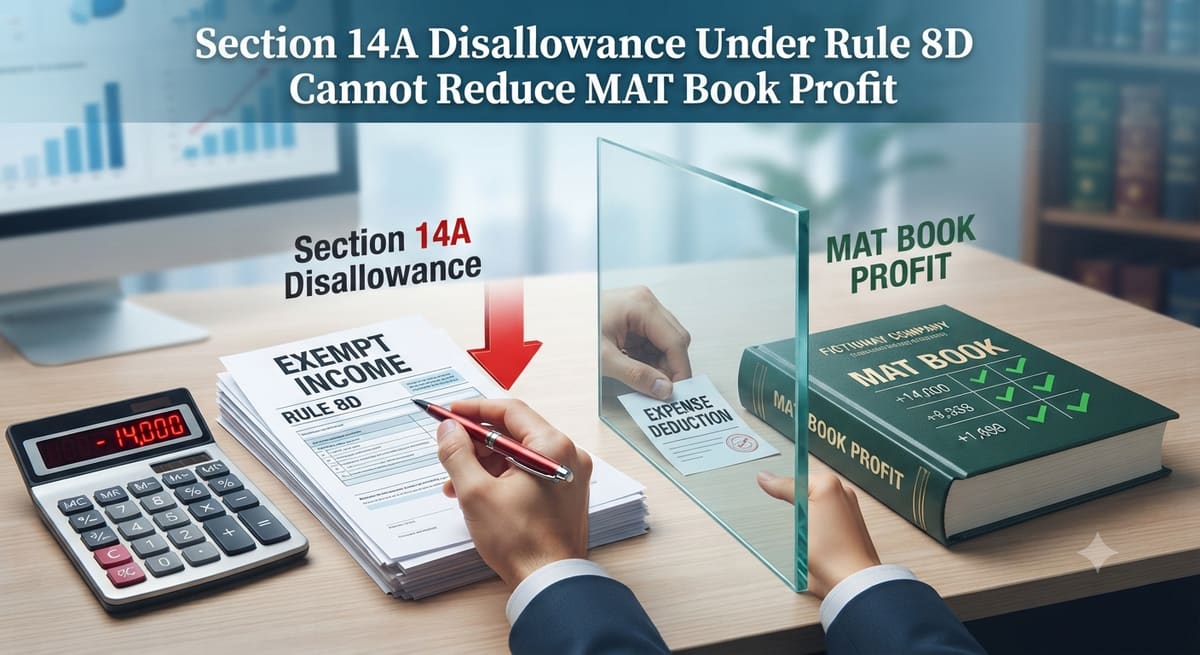
The Tribunal first examined section 14A(2) and sub-rule (1) of rule 8D, holding that the AO must first record dissatisfaction with the assessee’s claim before resorting to rule 8D. It observed that the 2016 amendment altered only the formula for computing disallowance, not the precondition of dissatisfaction. Since no such dissatisfaction was recorded, the disallowance under section 14A could not exceed the assessee’s suo moto amount of Rs.62,16,000. The Tribunal quoted:
"We find that resort can be had to rule 8D only after rejection of the assessee's apportionment on cogent grounds. In the instant case, no cogent reasons have been recorded by the AO for not accepting the assessee's computation and as such there no satisfaction recorded on the part of the AO that the assessee's claim is not correct."
Turning to depreciation, the Tribunal noted that section 32 permits depreciation on intangible assets acquired on or after 01.04.1998 used for business. It emphasized that the Finance Act, 2021 amendment discontinuing depreciation on goodwill is prospective, as clarified in the explanatory memorandum and affirmed in Asian Paints Ltd. v. ACIT, 2026 (6) TMI 1339 (Bom). The Tribunal further held that the ratio of CIT v Smifs Securities Ltd. applies equally to goodwill arising on demerger, and that the revenue’s reliance on United Breweries is inapplicable because that case involved goodwill already recorded in the transferor’s books. Consequently, the assessee’s claim for depreciation on goodwill (Rs.890.60 crore) and on brands and distribution network (Rs.614.76 crore) was allowed.
The Verdict
The appeal was partly allowed. The Tribunal set aside the disallowance of Rs.8,82,00,000 under section 14A, limiting it to the assessee’s suo moto disallowance of Rs.62,16,000. It directed the AO to allow depreciation of Rs.890.60 crore on goodwill and Rs.614.76 crore on brands and distribution network arising from the demerger. The matter of the assessee’s section 80G claim for deduction of Rs.7,12,68,956 (50% of donations of Rs.14,25,37,911) was remanded to the AO for consideration in accordance with law. The order was pronounced on 07.10.2026.
What This Means For Similar Cases
Depreciation on Intangibles Arising from Demerger Is Allowed
Practitioners can now claim depreciation under section 32 on goodwill, brands and similar intangibles acquired pursuant to a demerger where such assets were not recorded in the demerged company’s books, provided the acquisition is for consideration and the asset is used in the assessee’s business. The Finance Act, 2021 bar on depreciation applies only from AY 2021-22 onward.
Section 14A Requires Recorded Dissatisfaction
The AO must expressly record his dissatisfaction with the assessee’s claim before applying rule 8D; mere disagreement or reliance on a formula is insufficient. Absent such recording, the disallowance cannot exceed the assessee’s own suo moto disallowance.
Prospective Effect of Finance Act, 2021 Amendment
The amendment discontinuing depreciation on goodwill has prospective effect from AY 2021-22. Claims for earlier assessment years remain governed by the pre-amendment position, allowing depreciation on goodwill arising from amalgamation or demerger.