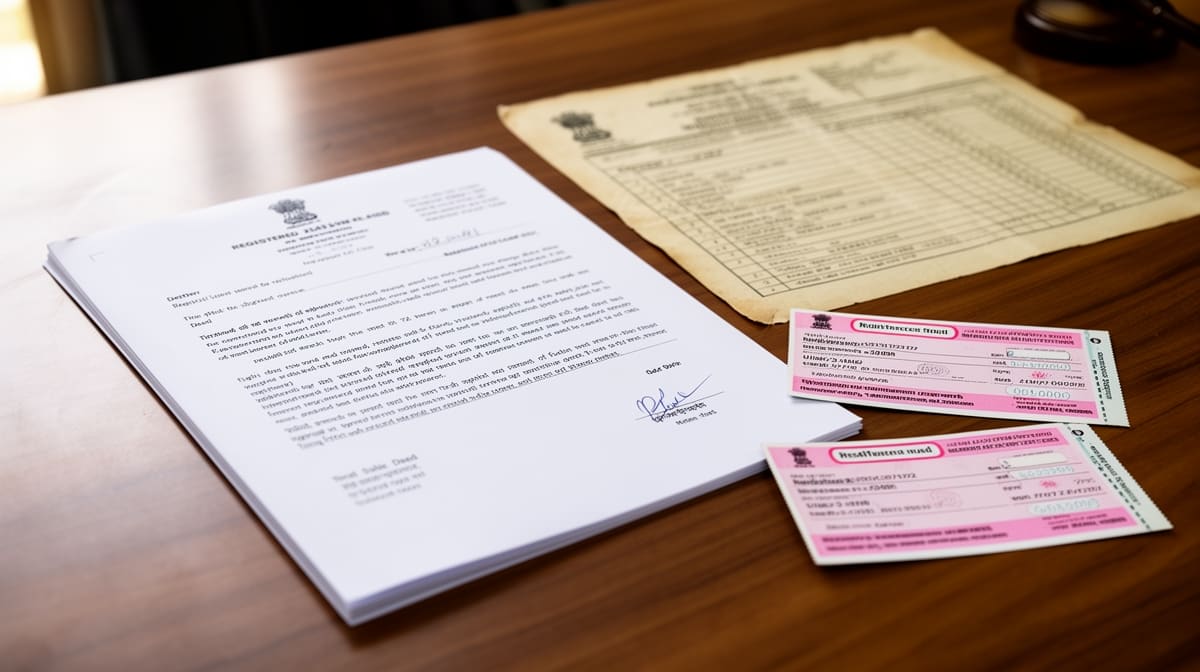
The Chhattisgarh High Court has clarified that a liquidator of a cooperative society cannot unilaterally cancel a registered sale deed, even if the original transaction contained conditions for construction. Such an act, being wholly without jurisdiction, cannot be validated by the de facto doctrine or subsequent transfer to a third party. The judgment reinforces the principle that vested property rights can only be extinguished through a decree of a competent civil court.
Background & Facts
The Dispute
The dispute centers on the ownership of residential plot No. B-25, measuring 2400 sq. ft. (60 x 40 ft.), situated at Village Purena, R.I. Circle Raipur, which was originally allotted by the National Mineral Development Corporation Employees Society Limited (the Society). The plaintiff, Devashish Panda, purchased the plot through a registered sale deed dated 16-07-2001 from M.A. Appan, who had himself acquired it from the Society via a sale deed dated 03-03-1994. The plaintiff constructed a boundary wall and water tank on the land and maintained possession. In 2011, the Society went into liquidation, and its liquidator, Defendant No. 3 (Rajkumar Naidu), executed a revocation deed and a sale deed on 10-03-2011, cancelling the plaintiff’s allotment and transferring the plot to Defendant No. 4, Smt. Chhaya Devi Agrawal.
Key Facts
- The original sale deed dated 03-03-1994 in favor of M.A. Appan contained Clause 2 requiring commencement of construction within six months and completion within three years, with forfeiture of allotment for non-compliance.
- The plaintiff’s sale deed dated 16-07-2001 did not contain any such condition, though he was bound by the Society’s By-Laws.
- The plaintiff did not commence construction within three years of the 2001 sale deed.
- On 04-01-2011, the Society issued a notice to the plaintiff to commence construction within 21 days or face cancellation.
- On 25-02-2011, a second notice was issued, informing the plaintiff of cancellation of his allotment.
- On 10-03-2011, the liquidator executed two documents on the same day: (i) a cancellation deed (Ex. P-9) revoking the plaintiff’s allotment, and (ii) a sale deed (Ex. D-1) in favor of Defendant No. 4 for Rs. 2,40,000.
- The cancellation deed claimed that the consideration amount of Rs. 1,85,000 was refunded via Cheque No. 689673, but the plaintiff denied receiving it.
- Defendant No. 4’s name was entered in municipal records on 15-09-2011, and she obtained building permission.
- The plaintiff filed a civil suit on 16-05-2011 seeking declaration of title and permanent injunction.
- Defendant No. 4 filed a counter-claim for declaration of title and injunction.
- Defendant No. 4 did not examine herself as a witness; her case was supported by D.W. 1, Anil Agrawal, who admitted he was not her power of attorney holder and had no personal knowledge of the cancellation or sale deeds.
Procedural History
- 16-07-2001: Plaintiff purchases plot via registered sale deed from M.A. Appan.
- 04-01-2011: Society issues notice to plaintiff to commence construction within 21 days.
- 25-02-2011: Second notice issued, informing cancellation of allotment.
- 28-01-2011: Rajkumar Naidu appointed liquidator of the Society.
- 10-03-2011: Liquidator executes cancellation deed (Ex. P-9) and sale deed (Ex. D-1) in favor of Defendant No. 4 on the same day.
- 13-05-2011: Plaintiff obtains copy of sale deed.
- 16-05-2011: Plaintiff serves legal notice under Section 94 of the Cooperative Societies Act, 1960 and Section 80 CPC.
- 12-06-2013: Civil Suit No. 59-A/2013 filed by plaintiff.
- 05-10-2018: Trial Court decrees plaintiff’s suit, declares sale deed dated 10-03-2011 void, grants permanent injunction, and dismisses counter-claim.
- 05-10-2018: Judgment and decree passed by 4th Additional Judge, Court of First Additional District Judge, Raipur.
- 09-09-2019: First Appeal No. 99 of 2019 filed by Defendant No. 4 before the High Court.
- 15-12-2025: Judgment reserved.
- 24-03-2026: Judgment delivered.
The Parties' Positions
Plaintiff (Respondent No. 1): Argued that the registered sale deed dated 16-07-2001 transferred absolute title, and no party, including the Society or its liquidator, could unilaterally cancel it. Relied on Sections 54, 10, 11, and 31 of the Transfer of Property Act, 1882, and Section 31 of the Specific Relief Act, 1963.
Defendant No. 4 (Appellant): Contended that the plaintiff violated the By-Laws by not commencing construction, thereby triggering the condition subsequent under Clause 2 of the original sale deed. Argued that the liquidator had statutory authority under Sections 69-71 of the Chhattisgarh Cooperative Societies Act, 1960 to cancel non-compliant allotments and re-allot the land. Invoked the de facto doctrine to protect the acts of the liquidator despite possible irregularities in his appointment.
Relief Sought
The plaintiff sought: (1) declaration that he is the lawful owner and in possession of the plot; (2) declaration that the cancellation deed and sale deed dated 10-03-2011 are void and not binding; and (3) permanent injunction restraining Defendant No. 4 from interfering with his possession.
Defendant No. 4 sought: (1) declaration that she is the lawful owner; (2) declaration that the plaintiff’s title is extinguished; and (3) permanent injunction in her favor.
The Legal Issue
The central question was whether a liquidator of a cooperative society, acting under the Chhattisgarh Cooperative Societies Act, 1960, has the statutory authority to unilaterally cancel a registered sale deed and transfer title to a third party, and whether such an act, being wholly without jurisdiction, can be validated by the de facto doctrine.
Arguments Presented
For the Appellant
The appellant relied on Gokaraju Rangaraju v. State of Andhra Pradesh, Aman Semi-Conductors (Private) Limited v. Haryana State Industrial Development Corporation Limited, and Pushpa Devi M. Jatia v. M.L. Wadhawan to argue that the liquidator’s acts, even if procedurally irregular, were protected under the de facto doctrine. She contended that the Society’s By-Laws and the original sale deed contained a valid condition subsequent under Section 31 of the Transfer of Property Act, 1882, which permitted cancellation upon non-compliance. The liquidator, she argued, was empowered under Sections 69-71 of the Cooperative Societies Act to realize assets and cancel irregular allotments. The sale to her was for value, and she was recorded in municipal and revenue records as the owner.
For the Respondent
The respondent argued that once a registered sale deed is executed, absolute title passes to the transferee under Section 54 of the Transfer of Property Act, 1882. Any condition restricting enjoyment or enabling automatic forfeiture is void under Sections 10 and 11 of the same Act. The liquidator, he submitted, had no adjudicatory power to cancel a registered instrument; such power rests exclusively with a civil court under Section 31 of the Specific Relief Act, 1963. The liquidator’s acts were not merely irregular but wholly without jurisdiction, rendering the de facto doctrine inapplicable. The failure of Defendant No. 4 to examine herself and the absence of proof of refund to the plaintiff further undermined her claim.
The Court's Analysis
The Court undertook a detailed analysis of the statutory framework governing cooperative societies and the Transfer of Property Act. It held that the execution of a registered sale deed under Section 54 of the Transfer of Property Act, 1882, transfers absolute ownership, leaving no residual interest in the original vendor. Any condition in the sale deed or By-Laws that purports to enable automatic forfeiture upon non-compliance is void under Section 11, which prohibits restrictions repugnant to an absolute interest.
"The law is well settled that a registered sale deed cannot be cancelled unilaterally by the vendor or any authority claiming under him. Such cancellation must be effected only by a decree of a competent civil court under the provisions of the Specific Relief Act, 1963, particularly Sections 31 and 34."
The Court examined Sections 69, 70, and 71 of the Chhattisgarh Cooperative Societies Act, 1960, and concluded that the powers of a liquidator are administrative and facilitative - limited to taking custody of assets, realizing dues, and distributing proceeds. The liquidator has no adjudicatory authority to annul vested rights or cancel registered instruments. The Court distinguished between acts done in irregular exercise of lawful authority and acts done in complete absence of jurisdiction, citing Gokaraju Rangaraju and Aman Semi-Conductors. The cancellation of a registered sale deed, the Court held, falls squarely in the latter category.
The Court further rejected the invocation of the de facto doctrine, emphasizing that it protects only acts performed under color of lawful authority, not those that are jurisdictionally void. The liquidator’s act of cancelling the plaintiff’s title was not merely procedurally flawed - it was substantively beyond his statutory mandate.
The Court also noted the procedural defect in Defendant No. 4’s case: she did not examine herself as a witness, and her sole witness, Anil Agrawal, admitted he had no personal knowledge of the cancellation or sale deeds. The Court applied the principle from Vidyadhar v. Manikrao, holding that failure to testify gives rise to an adverse inference.
Finally, the Court held that even if Defendant No. 4 was a bona fide purchaser, she could not acquire a better title than her transferor. Since the Society and its liquidator had no valid title to transfer, the sale deed in her favor was void ab initio. Revenue entries, the Court reiterated, are not title documents.
The Verdict
The appeal was dismissed. The High Court affirmed the trial court’s judgment and decree dated 05-10-2018, upholding the plaintiff’s title and possession over the suit property. The cancellation deed dated 10-03-2011 and the sale deed in favor of Defendant No. 4 were declared void and non est in law. The plaintiff’s claim for permanent injunction was upheld. Parties were directed to bear their own costs. No monetary compensation or interest was awarded, as the relief sought was declaratory and injunctive.
What This Means For Similar Cases
Registered Sale Deeds Cannot Be Cancelled Unilaterally
- Practitioners must now argue that any attempt by a society, cooperative, or liquidator to cancel a registered sale deed without a court decree is legally void.
- The burden shifts to the party seeking cancellation to prove that the transaction was not an absolute conveyance under Section 54 of the Transfer of Property Act.
- Conditional clauses in sale deeds that purport to enable automatic forfeiture are unenforceable if they conflict with Section 11.
De Facto Doctrine Has Strict Limits
- The de facto doctrine cannot cure jurisdictional defects - only procedural irregularities.
- Where an officer has no legal authority to act (e.g., cancelling a registered title), the doctrine offers no protection, even if the officer was acting under color of office.
- This principle applies equally to liquidators, receivers, and statutory authorities acting beyond their statutory mandate.
Witness Testimony Is Critical in Title Disputes
- Parties claiming title through counter-claims must personally testify to substantiate their assertions.
- Failure to appear as a witness invites adverse inference under Section 114 of the Evidence Act, as affirmed in Vidyadhar v. Manikrao.
- Third-party witnesses who lack personal knowledge of key transactions cannot validate claims of ownership.