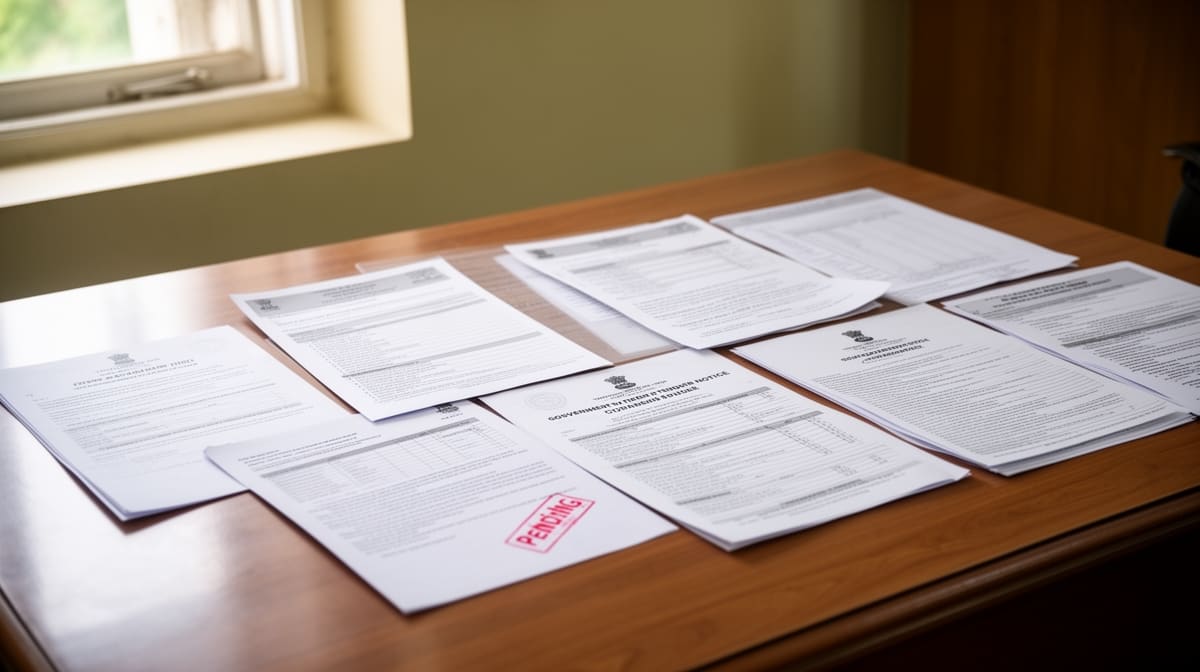
The Rajasthan High Court has affirmed that suppressing a prior debarment in a tender affidavit constitutes fraud, even if the debarment period had expired at the time of bid submission. This ruling reinforces the duty of full disclosure under tender codes of integrity and invalidates contracts rooted in material misrepresentation.
Background & Facts
The Dispute
The petitioner, M/s. Sahara Ex Servicemen Welfare Co-Operative Society Limited, participated in a tender issued by the Jaipur Development Authority (JDA) for providing security personnel services. The tender required bidders to submit a notarized affidavit affirming they had never been debarred, blacklisted, or declared a defaulter by any government or semi-government entity. The petitioner was declared the successful bidder and awarded a work order and contract dated 24.11.2025. Subsequently, JDA discovered that the petitioner had been debarred by Sawai Mansingh Hospital (SMS Hospital) from 09.12.2024 to 06.06.2025, a fact not disclosed in the affidavit.
Key Facts
- The JDA issued the Notice Inviting Bid (NIB) on 08.08.2025 (Annexure-3)
- The petitioner submitted its bid along with a notarized affidavit dated 27.08.2025 (Annexure-4)
- The affidavit contained a categorical declaration: "The petitioner has never been debarred, blacklisted, or declared a defaulter by any government department, board, corporation, authority, council, hospital, semi-government department, or co-operative unit"
- The petitioner was awarded the work order on 24.11.2025 (Annexure-5) and executed a contract on the same date (Annexure-6)
- On 09.12.2024, SMS Hospital issued an order debarring the petitioner for six months, effective until 06.06.2025
- The debarment period expired before the NIB was issued and before the bid was submitted
- On 02.02.2026, respondent No.3 issued a Show Cause Notice (Annexure-7) alleging suppression of material fact
- The petitioner’s reply was deemed evasive and unsatisfactory
- On 18.03.2026, respondent No.3 issued the impugned order cancelling the work order and contract, forfeiting the bank guarantee, and debarred the petitioner from future tenders for six months (Annexure-10)
Procedural History
- 08.08.2025: JDA issued NIB
- 27.08.2025: Petitioner submitted bid with affidavit
- 24.11.2025: Work order and contract awarded
- 02.02.2026: Show Cause Notice issued
- 18.03.2026: Impugned cancellation order passed
- 29.04.2026: Judgment pronounced in Writ Petition No. 5442/2026
The Parties' Positions
Petitioner’s Position: The debarment by SMS Hospital had expired on 06.06.2025, and the NIB was issued on 08.08.2025. The petitioner acted in good faith, believing that past debarments, once expired, did not require disclosure. The affidavit was truthful as of the bid date.
Respondents’ Position: The tender’s Code of Integrity (Annexure A, Clause h) required disclosure of any debarment within the last three years. The petitioner deliberately concealed a material fact to gain an unfair advantage. The affidavit was false and concocted, rendering the entire bid void.
Relief Sought
The petitioner sought quashing of the cancellation order dated 18.03.2026, restoration of the work order and contract, and release of the forfeited bank guarantee.
The Legal Issue
The central question was whether suppression of a past debarment, even if expired at the time of bid submission, constitutes fraudulent practice under a tender’s Code of Integrity requiring mandatory disclosure of prior transgressions within a specified period.
Arguments Presented
For the Petitioner
The petitioner’s counsel, Mr. Jagmohan Saxena, argued that the debarment by SMS Hospital had lapsed on 06.06.2025, and the NIB was issued on 08.08.2025. Therefore, at the time of bid submission, the petitioner was not under any active debarment. The affidavit, which stated the petitioner had "never been debarred," was factually accurate as of 27.08.2025. The petitioner acted in bona fide belief and could not be penalized for non-disclosure of an expired sanction. Reliance was placed on the principle of proportionality and the absence of any express clause mandating disclosure of expired debarments.
For the Respondent
Ms. Ambika Sharma, counsel for JDA, contended that Annexure A, Clause (h) of the Tender Document explicitly required disclosure of any debarment by any procuring entity within the last three years. The debarment by SMS Hospital fell squarely within this window. The petitioner’s affidavit was not merely incomplete - it was a positive misrepresentation. The Supreme Court in The State of Madhya Pradesh v. U.P. State Bridge Corporation Limited and M/s. Sciemed Overseas Inc. v. BOC India Limited had held that suppression of adverse facts, even if technically expired, constitutes fraudulent practice under tender law. The respondents acted within their contractual rights under Clause 13 of the NIB to cancel the award and impose debarment.
The Court's Analysis
The Court examined the language of the tender document, particularly Clause 13 of Annexure-I and Clause (h) of Annexure A, which mandated disclosure of "any previous transgressions" or "any debarment by any other procuring entity" within the last three years. The Court emphasized that the purpose of such clauses is not merely to assess current eligibility but to evaluate the bidder’s commercial integrity and past conduct.
"The affidavit qua declaration of blacklisting, debarment, or being declared a defaulter by any procuring entity is required to analyze the past operational record and commercial integrity of the bidder, and therefore, the petitioner cannot escape from its liability by taking a plea that at the time of the submission of the bid, the petitioner was not actively debarred by any procuring entity."
The Court rejected the petitioner’s argument that an expired debarment was irrelevant. It held that the Code of Integrity was designed to prevent bidders from benefiting from past misconduct by simply waiting for the sanction to lapse. The omission was not a mere technicality - it was a deliberate concealment of a material fact that directly impacted the fairness of the bidding process.
The Court relied on The State of Madhya Pradesh v. U.P. State Bridge Corporation Limited, where the Supreme Court held that omission of facts to influence the bidding process constitutes a "fraudulent practice." It further cited M/s. Sciemed Overseas Inc. v. BOC India Limited, which condemned the rising trend of false affidavits in commercial contracts as an "unhealthy" practice that must be strongly discouraged.
The Court concluded that the petitioner’s conduct met the threshold of fraud: intentional concealment of a relevant fact, with the intent to gain an unfair advantage, in violation of a clear contractual obligation. The respondents’ action - cancellation, forfeiture, and six-month debarment - was proportionate, procedurally fair, and in accordance with the tender terms.
The Verdict
The writ petition was dismissed. The Court upheld the cancellation order dated 18.03.2026, confirming the termination of the work order and contract, forfeiture of the bank guarantee, and imposition of a six-month debarment from participating in any future tenders issued by JDA. No costs were awarded.
What This Means For Similar Cases
Disclosure Obligations Extend Beyond Active Status
- Practitioners must advise clients that even expired debarments, suspensions, or penalties must be disclosed if the tender requires disclosure of "past transgressions" or "last three years"
- A bidder cannot rely on the technical expiry of a sanction to justify non-disclosure if the tender document mandates retrospective reporting
- Legal due diligence for tenders must include comprehensive audit of all past disciplinary actions, regardless of current status
False Affidavits in Tenders Are Now Clearly Fraudulent
- Courts will treat deliberate omission of adverse history in tender affidavits as fraud, not mere procedural lapse
- The Sciemed Overseas precedent now binds all public procurement authorities to treat such conduct as grounds for immediate disqualification and debarment
- Bidders must treat tender affidavits as legally binding declarations - false statements may trigger criminal liability under IPC Section 191-193
Contractual Clauses Trump General Legal Assumptions
- Tender documents are binding contracts; their specific clauses override general assumptions about relevance of expired sanctions
- Clause 13 and Annexure A(h) created a higher standard than general law - bidders must comply with the document’s exact terms
- Public authorities are empowered to enforce strict compliance without needing to prove actual financial loss or competitive prejudice