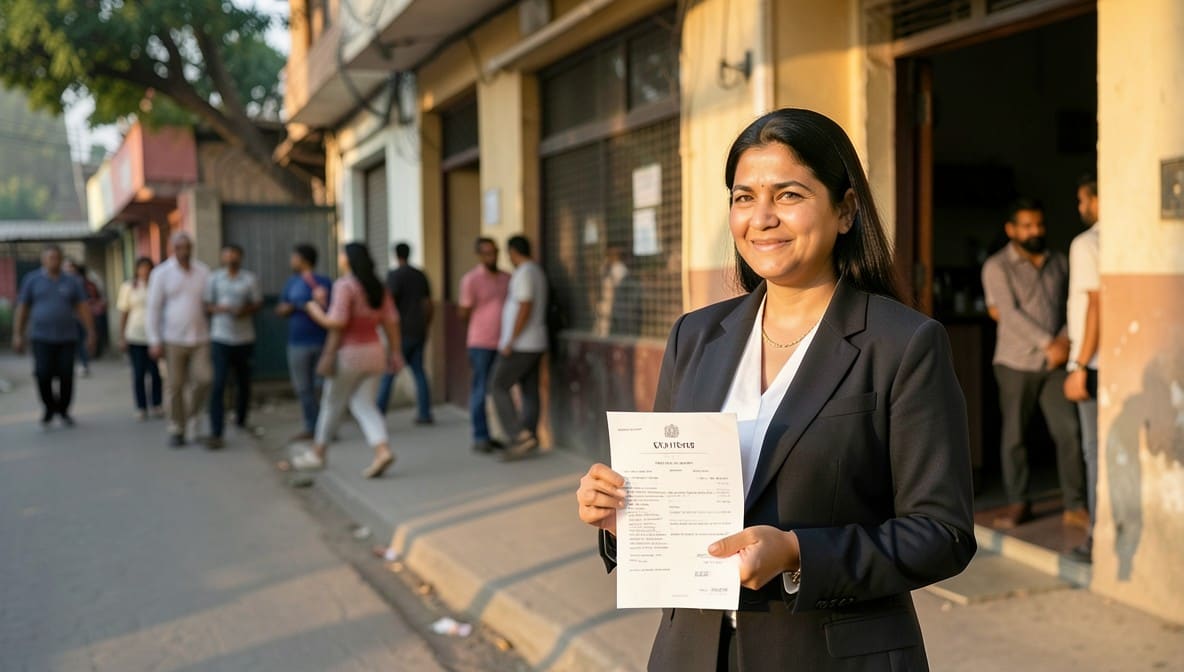
The Punjab and Haryana High Court has clarified that declaring an accused a proclaimed person cannot be automatic when absence stems from genuine personal hardship, not deliberate evasion. The judgment emphasizes judicial discretion in balancing procedural compliance with the accused’s right to fair trial, setting a precedent for compassionate yet structured intervention in prolonged criminal proceedings.
Background & Facts
The Dispute
The petitioner, Mandeep Kaur Monga, is accused in FIR No. 15 dated 07.02.2016, registered at Police Station Division No.6, Police Commissionerate, Jalandhar, under Sections 294, 506, 427 IPC (now corresponding to Sections 296, 351(2)(3), and 324(4)/(5) of the Bharatiya Nagarik Suraksha Sanhita, 2023). The case involves allegations of criminal intimidation, mischief, and insult with intent to provoke breach of peace.
Key Facts
- The petitioner was initially granted anticipatory bail on 05.10.2019.
- She appeared before the trial court regularly until the death of her mother, after which she ceased to appear.
- She was declared a proclaimed person on 15.05.2023, following cancellation of bail on 02.12.2022.
- The petitioner was granted bail again on 19.10.2020 but later failed to appear due to domestic turmoil and mental distress arising from prolonged litigation.
- No FIR under Section 209 of the BNSS (equivalent to Section 174-A IPC) has been registered against her for absconding.
- The petitioner has consistently expressed willingness to surrender and resume proceedings.
Procedural History
- 07.02.2016: FIR registered at Police Station Division No.6, Jalandhar.
- 05.10.2019: Anticipatory bail granted to petitioner.
- Late 2019: Petitioner stopped appearing after mother’s death.
- 19.10.2020: Bail granted again; petitioner rejoined proceedings.
- 02.12.2022: Bail cancelled due to renewed non-appearance.
- 15.05.2023: Petitioner declared a proclaimed person by the Chief Judicial Magistrate, Jalandhar.
- 15.05.2025: Order reaffirming proclaimed person status passed (impugned order).
- 30.04.2026: Writ petition filed under Section 528 of BNSS heard and decided by the High Court.
Relief Sought
The petitioner sought quashing of the order dated 15.05.2025 declaring her a proclaimed person, and requested protection from arrest on condition that she surrenders before the trial court, furnishes fresh bail bonds, and undertakes to appear regularly in all future proceedings.
The Legal Issue
The central question was whether the declaration of an accused as a proclaimed person under Section 528 of BNSS can be sustained when the absence from proceedings is attributable to prolonged personal crises and mental distress, rather than intentional evasion of justice.
Arguments Presented
For the Petitioner
Learned counsel argued that the petitioner’s non-appearance was neither willful nor malicious but resulted from a cascade of personal tragedies - the death of her mother, domestic instability, and psychological strain from protracted litigation. She had previously appeared, was granted bail twice, and had never absconded with intent to frustrate justice. Counsel cited Ashish Kumar Honda @ Ashish Handa v. State of Punjab and Veena @ Veena Devi v. State of Punjab to show that courts have previously granted second chances where absence was not deliberate. The petitioner offered to surrender unconditionally and submit a binding affidavit to ensure future compliance.
For the Respondent
The State, through the DAG, opposed the petition, contending that repeated non-appearance over years constituted willful defiance of court process. The State argued that allowing leniency in such cases would encourage abuse of judicial goodwill and undermine the integrity of criminal proceedings. It maintained that once declared a proclaimed person, the accused must surrender and face trial without conditions.
The Court's Analysis
The Court acknowledged the State’s concern for procedural discipline but emphasized that the primary objective of criminal jurisprudence is not punishment of absence, but adjudication of guilt. It observed that courts must distinguish between deliberate evasion and absence caused by extraordinary personal circumstances.
"The paramount consideration of the Court is to secure presence of accused on each and every date for speeding up the trial for its final conclusion. Already Courts are flooded with so much litigation, resulting in slow pace of work, because of more than one reason. The required energy and manpower be used for expediting the proceedings of the Court, instead of running after the accused persons to get hold of them."
The Court relied on its own precedents in Ashish Kumar Honda and Veena Devi, noting that rigid application of proclaimed person status without examining the context defeats the purpose of justice. It held that the petitioner’s conduct, while non-compliant, did not meet the threshold of intentional avoidance. The absence was sporadic, preceded by prior appearances, and followed by expressions of willingness to cooperate.
The Court further noted the absence of any action under Section 209 of BNSS, indicating the State itself did not treat the petitioner as a fugitive requiring active apprehension. The Court concluded that the interests of justice would be better served by permitting the petitioner to rejoin proceedings under strict conditions, rather than perpetuating a stalemate.
The Verdict
The petition was allowed. The order dated 15.05.2025 declaring the petitioner a proclaimed person was set aside. The petitioner is directed to surrender before the trial court on or before 15.05.2026. Upon surrender, she shall be released on bail upon furnishing fresh bail bonds and surety to the satisfaction of the trial court. She must submit a sworn affidavit undertaking to appear regularly in all future proceedings, absent prior court permission. Additionally, she shall deposit Rs. 25,000 as costs in an Old Age Home designated by the trial court within two weeks, failing which the order shall stand vacated.
What This Means For Similar Cases
Absence Due to Personal Crisis Requires Individualized Assessment
- Practitioners must now argue that non-appearance must be evaluated contextually - death of a close relative, mental health crisis, or prolonged litigation stress may constitute valid grounds for leniency.
- Courts cannot apply a blanket rule: repeated absence alone does not equate to intentional evasion.
- The burden shifts to the State to prove deliberate intent to abscond, especially where the accused has previously cooperated.
Judicial Efficiency Over Procedural Rigidity
- Courts are encouraged to prioritize trial completion over punitive declarations of proclaimed status.
- The judgment legitimizes conditional relief - surrender + undertaking + costs - as a viable alternative to arrest or prolonged fugitive status.
- Lawyers should proactively file petitions under Section 528 BNSS when clients face non-appearance due to verifiable hardship, attaching affidavits and medical records.
Costs as a Deterrent and Accountability Mechanism
- The imposition of Rs. 25,000 as costs payable to a social institution introduces a novel, non-punitive accountability measure.
- This model may be replicated in future cases to ensure compliance without incarceration.
- Practitioners should prepare clients for such cost obligations as part of settlement negotiations in criminal matters.