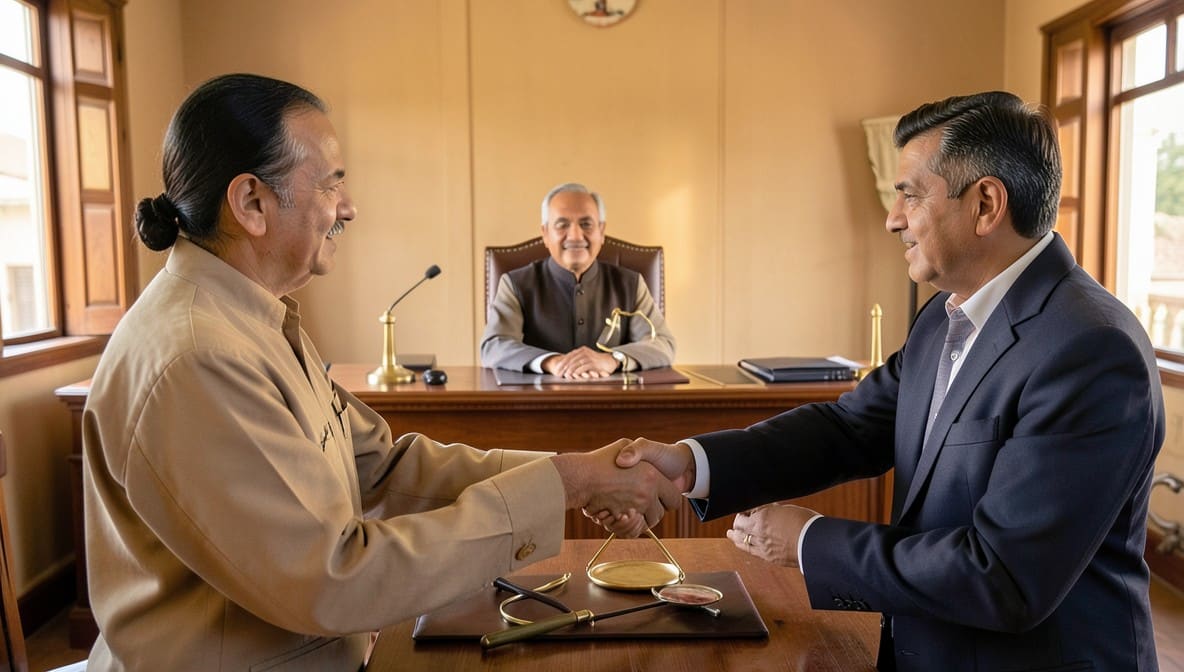
The Rajasthan High Court has reaffirmed that inherent powers under Section 528 of the Bharatiya Nagarik Suraksha Sanhita (BNSS) may be invoked to quash criminal proceedings where parties have settled their dispute, provided the offence lacks heinousness and is predominantly civil in nature. This decision reinforces the principle that not all criminal cases must proceed to trial when justice is better served by termination.
Background & Facts
The Dispute
The petitioners, Omprakash and Manohar Lal, were named in FIR No. 11/2026 registered at Police Station Asop, District Jodhpur Rural, for alleged offences under Sections 189(2), 115(2), 110, 125 and 324(5) of the Bharatiya Nagarik Suraksha Sanhita (BNS), and Sections 3(1)(r), 3(1)(s), and 3(2)(va) of the Scheduled Castes and Scheduled Tribes (Prevention of Atrocities) Act, 1989. The complainant, Navlaram, alleged acts of assault, intimidation, and caste-based harassment stemming from a longstanding land and personal dispute.
Key Facts
- The incident allegedly occurred on 10.01.2026 in the village of Asop, Tehsil Bhopalgarh
- FIR was registered on 15.01.2026 following a complaint by Navlaram
- No arrests were made; petitioners were not in custody at the time of filing
- The dispute originated from a boundary disagreement and prior verbal altercations between families
- No prior criminal history was recorded against either party
- The complainant is a member of the Scheduled Caste, as are the petitioners
Procedural History
- 10.01.2026: Alleged incident occurred
- 15.01.2026: FIR No. 11/2026 registered at PS Asop
- 20.01.2026: Petitioners applied for anticipatory bail, which was not opposed
- 10.02.2026: Parties entered into a written compromise agreement before a village panchayat
- 15.02.2026: Compromise deed executed and signed by both parties, witnessed by five villagers
- 20.02.2026: Complainant filed an affidavit before the court stating withdrawal of complaint and desire to settle
- 25.03.2026: Petitioners filed the present Criminal Miscellaneous Petition under Section 528 BNSS
- 27.04.2026: Hearing concluded before Justice Baljinder Singh Sandhu
Relief Sought
The petitioners sought quashing of FIR No. 11/2026 and all proceedings arising therefrom, arguing that the compromise was genuine, voluntary, and rendered further prosecution unjust.
The Legal Issue
The central question was whether the High Court may exercise its inherent jurisdiction under Section 528 of the BNSS to quash criminal proceedings arising from non-heinous offences after a genuine compromise between the parties, particularly where the dispute has a predominantly civil or personal character.
Arguments Presented
For the Petitioner
Mr. Bajrang Singh, counsel for the petitioners, submitted that the dispute arose from a private land boundary conflict and personal friction, not caste-based animosity. He emphasized that the compromise was documented, witnessed, and accepted by the complainant, who had filed an affidavit withdrawing his complaint. He relied on Gian Singh v. State of Punjab to argue that offences with civil flavour, even if technically falling under special statutes, may be quashed if the nature of the wrong is personal and the public interest is not significantly affected. He contended that Sections 189(2), 115(2), 110, 125, and 324(5) of BNS are not inherently heinous, and the SC/ST Act provisions invoked were ancillary to the primary civil dispute.
For the Respondent
Ms. Sonu Manawat, Public Prosecutor, acknowledged the compromise and confirmed that the complainant no longer wished to pursue the case. She did not oppose the quashing but requested the Court to record the compromise and ensure no coercion was involved. She did not contest the applicability of Gian Singh but sought judicial scrutiny to confirm the genuineness of settlement.
The Court's Analysis
The Court examined the nature of the offences alleged and the context of the compromise. It noted that while the SC/ST Act is a special statute designed to protect vulnerable communities, the invocation of Sections 3(1)(r), 3(1)(s), and 3(2)(va) in this case was not substantiated by evidence of caste-based humiliation or systemic discrimination. The alleged acts - threats, minor assault, and property dispute - were found to be rooted in a personal conflict rather than caste-based persecution.
The Court emphasized that the Supreme Court in Gian Singh v. State of Punjab had clearly delineated the scope of inherent powers under Section 482 CrPC (now Section 528 BNSS), holding that quashing is permissible where the offence is not heinous and the dispute is essentially civil or personal. The Court observed:
"The criminal cases having overwhelmingly and pre-dominantly civil flavour stand on different footing for the purposes of quashing, particularly the offences arising from commercial, financial, mercantile, civil, partnership or such like transactions or the offences arising out of matrimony relating to dowry, etc. or the family disputes where the wrong is basically private or personal in nature and the parties have resolved their entire dispute."
The Court found that the present case fell squarely within this category. It noted the absence of any prior history of caste-based violence, the voluntary nature of the compromise, and the complainant’s unequivocal withdrawal of complaint. The Court further held that continuing the proceedings would serve no public interest and would amount to an abuse of process, given the complete resolution of the underlying dispute.
The Verdict
The petition was allowed. The High Court quashed FIR No. 11/2026 registered at Police Station Asop, District Jodhpur Rural, for offences under Sections 189(2), 115(2), 110, 125 and 324(5) of BNS and Sections 3(1)(r), 3(1)(s), and 3(2)(va) of the SC/ST Act. All subsequent proceedings arising from the FIR, including any investigation or trial, are hereby terminated. The Court directed the concerned police authorities to close the case file and inform the complainant and petitioners in writing within seven days.
What This Means For Similar Cases
Compromise Can Override Special Statutes When Offences Are Non-Heinous
- Practitioners may now argue that even offences under the SC/ST Act may be quashed if the alleged acts are incidental to a private dispute and lack the essential element of caste-based atrocity
- The burden shifts to the prosecution to demonstrate that the offence was motivated by caste animus, not personal grievance
- Mere membership of a Scheduled Caste by both parties does not automatically elevate a civil dispute to an atrocity under the SC/ST Act
Judicial Scrutiny of Compromise Is Mandatory, Not Formality
- Courts must independently verify the genuineness of compromise - no automatic quashing
- Affidavits, written deeds, and witness statements are critical evidence
- Compromise must be voluntary, without coercion, and reflect full understanding of consequences
Civil Flavour Trumps Statutory Classification
- The nature of the underlying dispute, not the label of the offence, determines quashability
- A simple assault under Section 324 BNS coupled with SC/ST Act provisions may be quashed if the context is familial or property-based
- This creates a new threshold: courts must analyze the substance of the allegation, not just the form of the charge