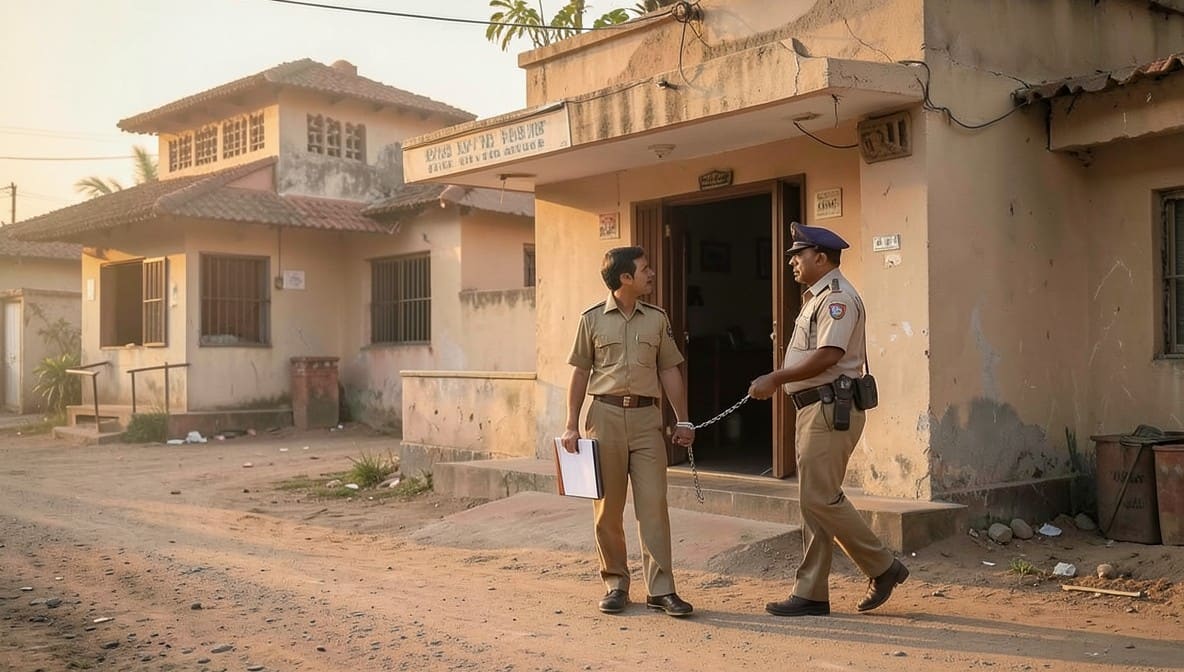
The Punjab and Haryana High Court has clarified that mere facilitation of weapons or vehicles in an organized crime, without direct participation in the homicidal act, does not automatically justify denial of bail. This ruling reinforces the principle that pre-trial detention must be proportionate to the accused’s actual role and the strength of evidence against them.
Background & Facts
The Dispute
The petitioner, Prbhjot Singh, is accused of facilitating the murder of Shantanu, a liquor contractor, by procuring a stolen motorcycle and two pistols for assailants linked to the Noni Rana gang. He was not named in the original FIR, which was filed based on a complaint by Prince, the driver who witnessed the attack. The murder occurred on 13.06.2025, and the FIR was registered under Sections 103(1), 111(2), 111(3), 111(5), 238, and 253 of the Bharatiya Nyaya Sanhita, 2023 (BNS), along with provisions of the Arms Act, 1959.
Procedural History
- 13.06.2025: Victim Shantanu shot dead during an ambush on a motorcycle.
- 14.06.2025: FIR registered after social media post claimed responsibility by Noni Rana gang.
- 23.06.2025: Petitioner arrested based on disclosure statements of co-accused Subham Khurana and circumstantial evidence.
- No recovery of weapons or vehicle from the petitioner.
- Investigation completed; trial pending.
Relief Sought
The petitioner seeks regular bail, arguing that his role was limited to logistical support, he was not named in the FIR, no incriminating material was recovered from him, and co-accused with similar roles have been granted bail.
The Legal Issue
The central question was whether Section 111 of the Bharatiya Nyaya Sanhita, which extends liability to persons aiding or abetting an offence, justifies denial of bail when the accused’s role is confined to facilitation without direct involvement in the commission of murder.
Arguments Presented
For the Petitioner
Learned counsel argued that the petitioner’s involvement was restricted to transporting and arranging a stolen motorcycle and weapons, based solely on disclosure statements of co-accused, which are inadmissible as substantive evidence under Section 27 of the Indian Evidence Act. He was not present at the crime scene, no recovery was made from him, and he has no prior criminal record. His detention since June 2025 is prolonged without concrete evidence linking him directly to the murder. Bail has been granted to co-accused Mohit Kumar and Dipender Pal Singh, whose roles were similarly peripheral.
For the Respondent
The State contended that the petitioner was an active member of an organized crime syndicate, and his actions in procuring and modifying the murder weapon and vehicle constituted a critical link in the conspiracy. The disclosure statements, corroborated by call detail records and CCTV footage, establish his participation in the chain of events leading to the murder. Given the gravity of the offence and the risk of witness tampering or absconding, bail would undermine public safety and the integrity of the investigation.
The Court's Analysis
The Court examined the nature of the petitioner’s alleged role and found it to be that of a facilitator, not a principal offender. While acknowledging the seriousness of the charges under Section 103(1) BNS, the Court emphasized that Section 111 BNS creates derivative liability, and its application must be assessed with caution in bail proceedings.
"His role is limited to facilitating firearms and motorbike and is distinct and remote offence from the direct commission of offence punishable under Section 103(1) of BNS."
The Court noted that the prosecution’s case rests heavily on disclosure statements, which are not admissible as evidence against the accused unless independently corroborated. No transcript of the call records was produced, and CCTV footage only showed him moving the motorcycle, not participating in the attack. The Court held that the material before it does not establish a prima facie case of direct participation or intent to kill.
The Court further observed that the petitioner had been in custody for over eight months without trial commencing, and the continued detention was disproportionate to the nature of his alleged conduct. The fact that co-accused with comparable roles had been granted bail reinforced the principle of parity in bail jurisprudence.
The Verdict
The petitioner won. The Court held that facilitation of weapons or vehicles in an organized crime, without direct involvement in the homicidal act, does not justify denial of bail. The petitioner was granted regular bail subject to personal and surety bonds and conditions including no contact with witnesses and no travel abroad.
What This Means For Similar Cases
Facilitation Roles Are Not Automatically Non-Bailable
- Practitioners must distinguish between principal offenders and logistical facilitators when arguing for or against bail.
- Merely being part of a gang or syndicate does not equate to active participation in the crime.
- Courts must assess the degree of involvement, not just the association.
Disclosure Statements Alone Are Insufficient for Bail Denial
- Disclosure statements under Section 27 of the Evidence Act cannot form the sole basis for denying bail.
- Independent corroboration - such as recovered weapons, forensic evidence, or eyewitness testimony - is required to establish a prima facie case.
- Call records without transcripts or CCTV footage without contextual analysis are inadequate to prove intent.
Parity Among Co-Accused Must Be Considered
- When co-accused with identical or lesser roles are granted bail, denial to another accused violates the principle of equal treatment under Article 14.
- Courts must justify deviations from parity with concrete, case-specific reasons.
- Failure to do so renders bail orders arbitrary and unsustainable.