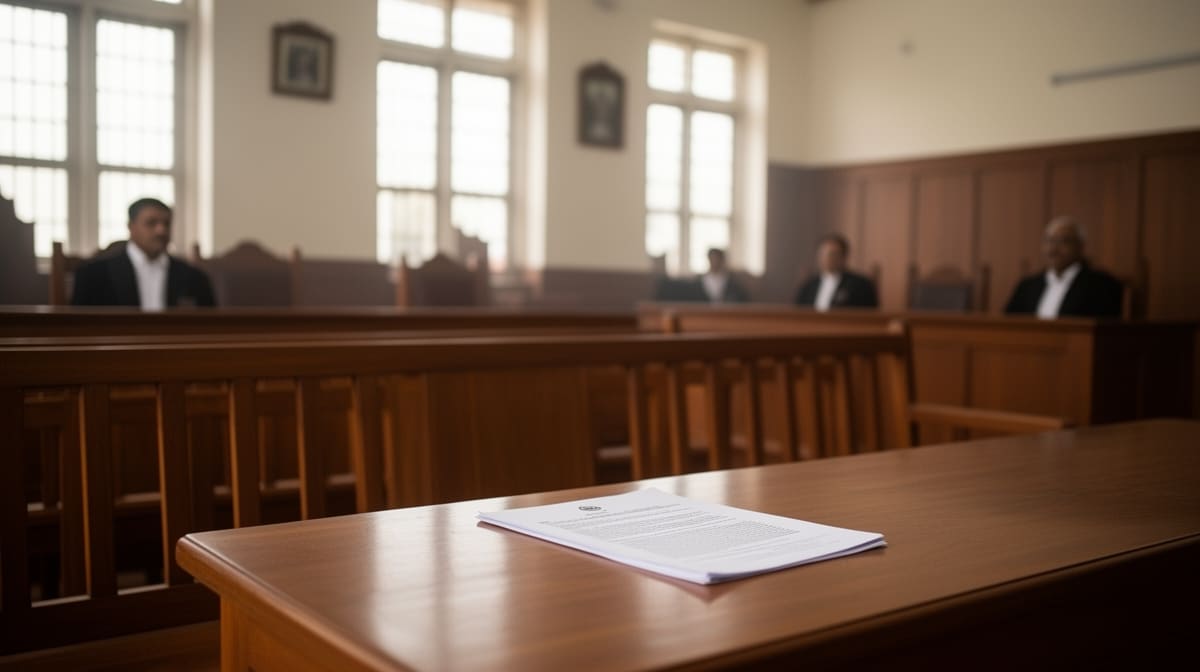
The Kerala High Court has clarified that mere association with a verbal altercation preceding a suicide does not justify denial of pre-arrest bail where no evidence links the accused to instigation or aiding the act. This ruling reinforces the principle that bail must be granted when custodial interrogation is unnecessary and no criminal antecedents exist.
Background & Facts
The Dispute
The petitioner, Mohammed Ashiq, aged 20, is the sixth accused in Crime No. 4/2026 registered at Sasthamcotta Police Station, Kollam District. The case arises from an alleged physical altercation involving the deceased, Jijo Varghese, following a verbal dispute with the first accused. The prosecution alleges that the petitioner, along with others, visited the deceased’s residence on the night of 31.12.2025, resulting in a scuffle and damage to the deceased’s vehicle. The deceased was found dead by suicide on the morning of 01.01.2026. The accused are charged under Section 108 read with Section 3(5) of the Bharatiya Nyaya Sanhita, 2023 (BNSS), which criminalizesabetting suicide.
Key Facts
- The alleged altercation occurred on the night of 31.12.2025
- The deceased was found dead by suicide on 01.01.2026
- The FIR was registered on 01.01.2026
- The petitioner has no prior criminal record
- The fifth accused in the same case was granted anticipatory bail on 02.02.2026 by the Sessions Court, Kollam
- No material evidence connects the petitioner to instigating or aiding the deceased’s suicide
- The case diary reveals no forensic, eyewitness, or digital evidence linking the petitioner to the deceased’s mental state or decision to end his life
Procedural History
- 01.01.2026: FIR registered at Sasthamcotta Police Station, Crime No. 4/2026
- 02.02.2026: Anticipatory bail granted to the 5th accused by the Sessions Court, Kollam (BA No. 158/2026)
- 06.03.2026: Sessions Court dismissed anticipatory bail application of the 4th accused (BA No. 403/2026)
- 06.04.2026: Petitioner filed this bail application under Section 482 of the Bharatiya Nagarik Suraksha Sanhita, 2023 (BNSS)
The Parties' Positions
Relief Sought
The petitioner seeks pre-arrest bail to prevent arbitrary arrest and custodial interrogation, arguing that he is falsely implicated with no evidence of involvement in the deceased’s suicide.
The Legal Issue
The central question was whether Section 482 of the Bharatiya Nagarik Suraksha Sanhita, 2023 permits pre-arrest bail when the accused is alleged to have been present during an altercation that preceded a suicide, but there is no evidence of instigation, coercion, or direct contribution to the deceased’s decision to end his life.
Arguments Presented
For the Appellant/Petitioner
The learned counsel argued that the petitioner is a young man with no criminal antecedents, and the prosecution has failed to produce any material connecting him to the deceased’s suicide. The presence at the scene of a scuffle does not equate to abetment under Section 108 BNSS. The counsel relied on Arnesh Kumar v. State of Bihar to emphasize that arrest is not automatic and custodial interrogation is unnecessary where the accused is not a flight risk or a threat to investigation. The fact that the fifth accused, on identical facts, was granted bail further supports parity.
For the Respondent/State
The Senior Public Prosecutor contended that the petitioner was part of a group that created a hostile environment leading to the deceased’s distress, and his release may hamper the investigation. He argued that the nature of the offence under Section 108 BNSS demands strict scrutiny and that the accused must be kept under custody to ensure evidence preservation and witness protection.
The Court's Analysis
The Court examined the distinction between mere presence at the scene and active participation in abetment. It noted that Section 108 BNSS requires proof of intentional act or illegal omission that directly instigates or aids suicide. The Court observed that the prosecution’s case rests on circumstantial proximity, not causal connection. The absence of any statement from the deceased, no threatening messages, no prior history of harassment, and no forensic link to the petitioner’s conduct rendered the allegation speculative.
"There is nothing on record to suggest that the applicant, in any way, aided or instigated the deceased in committing suicide."
The Court further held that the grant of anticipatory bail to the fifth accused, who stands on the same factual footing, creates a compelling precedent for parity under Article 14 of the Constitution. The Court emphasized that custodial interrogation is not a default requirement in cases where the accused is not a flight risk, has no history of tampering, and the investigation can proceed without detention. The Court rejected the State’s argument that the gravity of suicide-related offences automatically negates bail, stating that such an approach undermines the presumption of innocence.
The Verdict
The petitioner succeeded. The Court granted pre-arrest bail on the following conditions: (i) execution of a personal bond of Rs. 1,00,000 with two solvent sureties of like amount; (ii) cooperation with investigation including deemed police custody for discovery; (iii) mandatory appearance before the investigating officer every Saturday between 10.00 a.m. and 11.00 a.m. until further orders; (iv) no commission of similar offences; (v) no contact with prosecution witnesses or tampering with evidence; (vi) no departure from Kerala without court permission; and (vii) any application for modification or cancellation of bail to be filed in the jurisdictional court.
What This Means For Similar Cases
Presence Alone Does Not Constitute Abetment
- Practitioners must challenge bail denials where the prosecution relies solely on proximity to an incident preceding suicide
- Absence of direct communication, threats, or documented coercion negates the mens rea required under Section 108 BNSS
- Courts must distinguish between criminal liability and moral culpability
Custodial Interrogation Is Not Automatic
- Bail should be granted where the accused has no criminal record and the investigation can proceed without detention
- The burden shifts to the State to demonstrate why custody is necessary, not why release is dangerous
- Parity in bail grants among co-accused on similar facts is constitutionally mandated
Judicial Parity in Bail Matters
- When co-accused are granted bail on identical factual grounds, denial to another without distinction violates Article 14
- Courts must articulate clear, case-specific reasons for differential treatment
- This precedent strengthens arguments for bail in complex group offences where individual roles are unclear