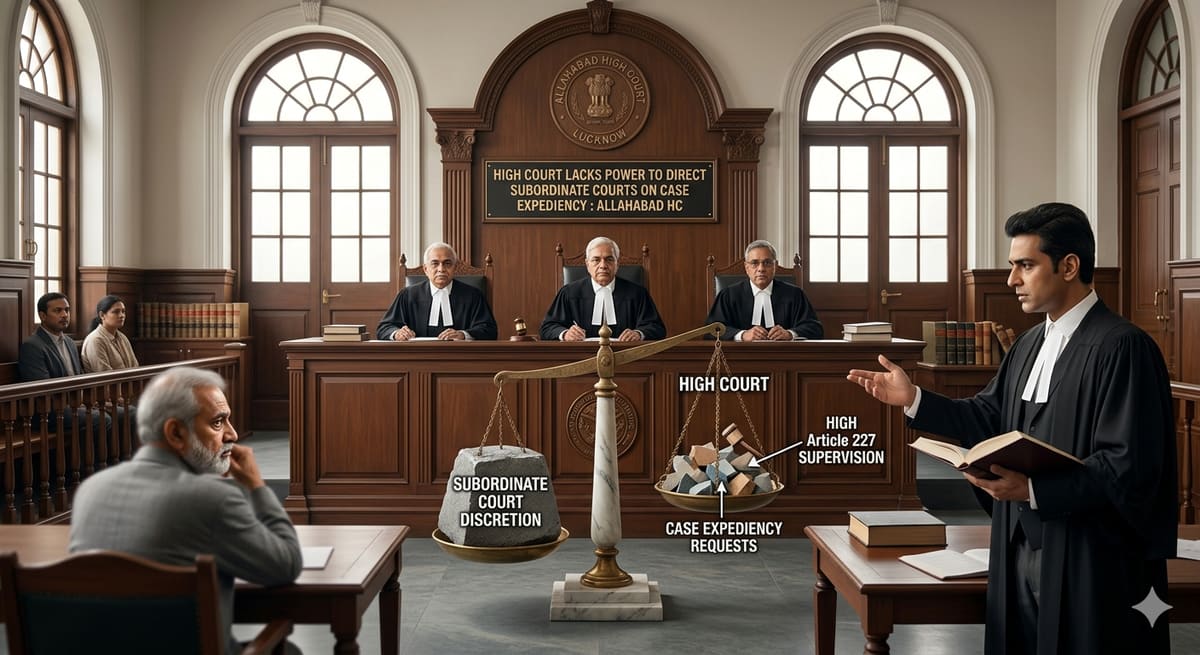
The Allahabad High Court has reiterated that constitutional courts should refrain from issuing directions to subordinate courts for the expeditious disposal of cases within a stipulated time, except in exceptional circumstances. This judgment underscores the principle that the prioritization of case disposal should be left to the discretion of the courts where the cases are pending, ensuring fairness and avoiding preferential treatment for litigants who approach higher courts.
Background & Facts
The Dispute
The petitioner, Lal Pratap, filed a writ petition under Article 227 of the Constitution seeking two primary reliefs: (1) the setting aside of an order dated 05.01.2023 passed by the Civil Judge (Junior Division), Jaunpur, in Suit No. 1219 of 2020 (Lal Pratap v. Ram Dulari and Others), and (2) a direction to the subordinate court for the expeditious disposal of the said suit within a stipulated time period, while maintaining status quo regarding the nature and possession of the suit property.
Procedural History
- 2020: Suit No. 1219 of 2020 (Lal Pratap v. Ram Dulari and Others) was filed before the Civil Judge (Junior Division), Jaunpur.
- 05.01.2023: An order was passed by the Civil Judge (Junior Division), Jaunpur, which is impugned in this writ petition.
- 2026: The present writ petition (No. 8734 of 2026) was filed before the Allahabad High Court seeking the aforementioned reliefs.
Relief Sought
The petitioner sought:
- A writ, order, or direction to set aside the order dated 05.01.2023 passed by the Civil Judge (Junior Division), Jaunpur.
- A direction to the subordinate court to dispose of Suit No. 1219 of 2020 expeditiously within a stipulated time period, as fixed by the High Court.
- An order to maintain status quo regarding the nature and possession of the suit property pending disposal of the suit.
The Legal Issue
The central question before the court was whether a constitutional court, under Article 227, can issue a mandatory direction to a subordinate court for the expeditious disposal of a pending suit within a stipulated time period, absent exceptional circumstances.
Arguments Presented
For the Petitioner
The petitioner contended that the subordinate court had delayed the disposal of Suit No. 1219 of 2020, necessitating the intervention of the High Court to ensure expeditious disposal. The petitioner relied on the general principle that justice delayed is justice denied and sought the High Court's direction to prioritize the suit.
For the Respondent
While the judgment does not explicitly detail the respondent's arguments, the legal position cited by the court suggests that the respondents would have contended that the High Court lacks the authority to direct subordinate courts to dispose of cases within a stipulated time, except in exceptional circumstances, as established by precedent.
The Court's Analysis
The court relied on two key precedents to resolve the legal issue:
-
Constitution Bench of the Supreme Court in High Court Bar Association, Allahabad v. State of Uttar Pradesh and Others ((2024) 6 SCC 267): The Supreme Court held that constitutional courts should ordinarily refrain from fixing a time-bound schedule for the disposal of cases pending before other courts. The issue of prioritizing case disposal should be left to the discretion of the courts concerned, except in exceptional circumstances. The court quoted para 47.3 of the judgment:
"Constitutional courts, in the ordinary course, should refrain from fixing a time-bound schedule for the disposal of cases pending before any other courts. Constitutional courts may issue directions for the time-bound disposal of cases only in exceptional circumstances. The issue of prioritising the disposal of cases should be best left to the decision of the courts concerned where the cases are pending;"
-
Division Bench of the Allahabad High Court in Ali Shad Usmani v. Ali Isteba (2015 (2) ADJ 250 (DB)): The Division Bench held that no direction can be issued to subordinate courts for deciding a suit within a stipulated period, as such orders could lead to preferential treatment for certain litigants while others with equally urgent matters are left to the normal course of adjudication. The court emphasized that the decision to expedite a case should be left to the judicious discretion of the trial judge, who may consider factors such as the litigant's age, disability, or socio-economic circumstances. The relevant portion of the judgment was quoted:
"We are not inclined to issue a direction for the expeditious hearing of a Civil Suit which is pending before the Civil Judge (Junior Division), District- Azamgarh. It would be most inappropriate to Court to entertain a writ petition under Article 226 and/or under Article 227 of the Constitution simply for the purpose of expediting the hearing of a suit. Such orders, if granted, place a class of litigants, who move the court in a separate and preferential category whereas other cases which may be of similar or greater antiquity and urgency are left to be decided in the normal channel. Hence, any such direction may be issued with the greatest care and circumspection by the High Court otherwise the Civil Courts will be overburdened only with requests for expeditious disposal of suits, which have been expedited by the High Court. Most of the litigants cannot afford the expense of moving the High court and would not, therefore, be in a position to have the benefit of such an order. Ultimately, it must be left to the judicious exercise of discretion of the concerned Court to determine whether a ground for urgency has been made out. We emphasize that there may be other cases such as involving senior citizens, those who are differently abled or people suffering from a particular disablilty socio-economic or otherwise which may prime cause of urgent disposal. It is for the learned Trial Judge in each case to apply his or her mind and decide whether the hearing of the suit to be expedited. For these reasons, we are not inclined to entertain the petition. The petition is, accordingly, dismissed. There shall be no order as to cost."
The Allahabad High Court, in light of these precedents, declined to issue a direction to the subordinate court for the expeditious disposal of the suit. The court noted that while the petitioner could move an application for expeditious disposal before the subordinate court, the decision to prioritize the case would rest with the trial judge, who would consider the pendency of cases and the dictum laid down by the Supreme Court.
The Verdict
The Allahabad High Court disposed of the writ petition with the following directions:
- The court declined to issue a direction to the subordinate court for the expeditious disposal of Suit No. 1219 of 2020 within a stipulated time period.
- The petitioner was permitted to move an application for expeditious disposal before the subordinate court, which would decide the same based on the pendency of cases and the principles laid down by the Supreme Court in High Court Bar Association, Allahabad v. State of Uttar Pradesh and Others.
- The writ petition was disposed of accordingly, with no order as to costs.
What This Means For Similar Cases
Discretion of Subordinate Courts in Case Prioritization
This judgment reinforces the principle that the prioritization of case disposal is primarily the discretion of the subordinate courts. Constitutional courts, including High Courts, should avoid issuing mandatory directions for expeditious disposal unless exceptional circumstances exist, such as cases involving senior citizens, differently-abled individuals, or socio-economic vulnerabilities.
Exceptional Circumstances as the Sole Basis for Intervention
Practitioners must note that:
- Directions for expeditious disposal under Article 227 can only be issued in exceptional circumstances, as defined by the Supreme Court and High Court precedents.
- The burden lies on the litigant to demonstrate urgency, which the trial judge must assess on a case-by-case basis.
Practical Implications for Litigants
- Litigants seeking expeditious disposal should first approach the subordinate court with an application highlighting the urgency of their case, supported by evidence (e.g., age, disability, or socio-economic hardship).
- Approaching the High Court under Article 227 for such reliefs should be a last resort, reserved for cases where the subordinate court has failed to exercise its discretion judiciously.